Wednesday, February 15, 2012

olas

An old friend of Levi's decided to visit Madrid last weekend, so despite the bitter cold, we went to meet up with him and explore the city we'd only briefly seen during paperwork visits. My previous impression had been a negative one, tainted by ugly bureaucratic buildings and 1960s commercial architecture, but I found myself pleasantly surprised by the beautiful, lively center of the city. We visited the famous plazas and parks, ate and drank in the exotic and varied sorts of places that don't exist in Zafra, and saw Picasso's Guernica at the Reina Sofia museum (it's surprisingly big). The highlight for me, in my ever-escalating nerdiness for the ancient, was a 2000-year-old temple, gifted to the city by the Egyptian government as a thanks for excavation assistance. It's a gorgeous little stone structure lined with miraculously intact hieroglyphics and altarpieces, dedicated to Isis and Amun and decorated by the Ptolemies and later completed by Augustus and Tiberius. I could have stayed in there all day.

We're budget travelers, (to put it gently; the more truthful description is that we cut every corner except wine and beer), so while Mike stayed in a comfortable, centrally-located hostel, Levi and I squeezed ourselves into the top bunk of a 20-year-old Romanian exchange student in a downtown expat neighborhood.

To explain:

Since moving to Europe, Levi and I have been couchsurfing, a strange and ostensibly reckless activity to most sane Westerners. The basic principle is simple enough: you put a facebook-like profile on couchsurfing.org, describing yourself and, if you are able/willing, offering up your couch or spare bedroom to complete strangers who might happen to be passing through your town. When you travel, you search for profiles of people living in your destination, and rather than paying for a hotel, you go sleep in their house.

While I recognize that it sounds like the beginning of a 90s slasher flick, or at least a desperate plea to be robbed blind, I've come to regard it as one of the best things the internet has to offer. In the ten or so times I've surfed or hosted surfers, I haven't had a single negative experience, nor have I met anyone who has. The system works on references, so when someone asked to stay with us, we can read all the things previous hosts have said about them, and thus far, all the references have turned out to be perfectly true. Even when we've taken the risk and stayed with a unreferenced newbie, it's been great.

I stayed with a group of happy-go-lucky Brazilian guys in Dublin and spent a great weekend with them and two German girls they were hosting. In Zafra, I stayed with a super hospitable Spanish woman who found us our apartment and would become a friend, student, and travel buddy. In Lisbon we spent 5 days in a gorgeous downtown apartment with a lifelong local who took us to his favorite restaurants and cafes. We've hosted twenty-somethings from France, the Czech Republic, Poland, Britain, America, Germany, and Austria; a Italian family with an 8-year-old daughter who knew only enough English to ask for juice, and a 70-year-old Englishman who had spent most of his adult life in Venezuela and skyped his son in Spanglish.

This most recent couchsurf landed us in Lavapiés, a trendy, bustling, international neighborhood a metro stop away from the city center. Despite the cold, the playgrounds, plazas, and sidewalk cafes were always alive with people speaking an incredible array of languages, moving in and out of the Indian, Mexican, Lebanese and Japanese restaurants. Our Romanian host lives in a small flat with a Polish couple, a French guy and a girl from Portugal. They are all students with Erasmus, a Europe-wide university exchange program, and they´re studying in English, although it's the native language of none of them.

The whole weekend was a perfect portrait of a modern, amalgomated European culture. Living in the very Spanish town of Zafra, it's easy to forget that this a globalized, progressive, diverse world exists here, and couchsurfing is a great lifeline to that world.

Thursday, January 26, 2012

training

Zafra enjoys a regional reputation and an ideal place for families and thus, despite its relatively small size, it is positively overflowing with children and teenagers. Partially because of its smallness and resulting lack of resources, but primarily due to its utter Spanishness, these hoards of under-18s, organized into their lifelong cliques and bands, entertain themselves by walking. They meet up in the plazas and parks and wander the streets in groups of five to ten kids, stopping at every snack store for gummies and chips. They storm cafes and restaurants, where sympathetic proprietors leave jugs of water on the bar to hydrate the kids in their roving. A few stop for a joint in the park, and some of the older ones dress up and try their luck at the less scrupulous pubs, but most are content to simply pass the evening engaging in that most Spanish of activities: socializing in the street. Groups come together, kisses are exchanged, gossip and small talk traded, and then the groups divide and move to the next block, to the next meeting. They're not going somewhere; the point is just the going, always with the expectation of not-so-chance encounters.

In the winter months, when temperatures occasionally hit freezing late at night and rain is more frequent, this activity loses some of its appeal. The American answer to this quandary is, naturally, to go to a friend's house. The problem here is that the group of close friends of the average Spanish teenager is not limited to the eight or so kids who join him on his evening walks, but rather extends to every one of those dozens of members of groups he meets. I once asked an eighth-grade student why he didn't just have his friends come hang out in his sizable living room. "Well," he said, with a tone that implied that I was missing something very obvious,"there are thirty-five of us."

The solution is the local. These thirty-five thirteen-year-olds pool their allowances and rent an empty office. Presumably borrowing from their parents' houses, they stock it with furniture and spend the cold evenings there with their mob of friends.

My parents would have never allowed this (for good reason), nor would have any other American parent I know. It would never have even occurred to me to request permission for such a thing. And what landlord would open his property to three dozen unsupervised kids?

But all my students insist that although the privilege is occasionally abused, the true purpose is just innocent socializing, and seem honestly confused that I would assume anything different. The mindset is just different here. Socializing with every person you know every single weekend is the normal course of things here, and when the weather prohibits street wandering, why should your social life suffer? They don't seem to be abusing the old-fashioned naivete of their parents, but actually provide it to be sound wisdom. It's Pleasantville.

But I suppose it's a means of feeding that natural Spanish lust for socialization and bonding. From the very beginning, they have their group, and they're not ever to be parted with them, especially not for something so trivial as cold rain or insufficient space. Because later in life they will drift bar to bar with that same core group, stopping for a drink in each place with the same satellite groups, exchanging kisses and gossip and small talk before going for a snack at the next tapas bar.

Friday, January 20, 2012

rocks

My Fridays are light, so I like to spend the open hours in the rocky green hills. It's a cool, sunny day and I'm seated in the front yard of what must have, at one time, been a charming little country house with a broad patio and lovely views of the olive groves, the village, and the Castellar. Now it's all mossy stucco and grassy floors, the uneven stones of its thick walls exposed and sprouting flowers, its roof disappeared and its windows collapsed, but the birds still love it, and I suspect it was a happy place.

I've come to love the mountains, the Pyrenees and the Andes and the Irish cliffs, but even (or maybe especially) the humble little ones like those that compose this forgotten Spanish sierra. I spent my childhood on the flat expanses of the Midwestern prairies, where you can see miles of corn and rest assured that, were you to traverse those miles, you would encounter still more corn. It's gorgeous in its own way, but I love the mystery of a mountainous horizon, where the peaks fade until their blue contours are indistinguishable from the sky, where the distance is inscrutable.

Monday, January 16, 2012

hunting

In late autumn, the sweltering Mediterranean air retreats as the Atlantic winds invade with their heavy clouds and blustery rains. This year, however, the two-week Christmas vacation happened to share its days with a rare phenomenon in Spanish winter: constant sunshine. We took advantaged of our reprieve from the dreary December and spent nearly every day of our holiday in the rocky green countryside just outside of town.

The dominant feature of this lovely landscape is the Castellar, a low ridge crowned with enormous vertical slabs of stone that appear to be bursting from the very soil. In past excursions to the top, Levi and I had discovered the ruins of rooms, walls, and foundations, and had learned upon asking around that a Moorish fortress had once watched over the town from those heights. But no one had much in the way of details; the Arab history of Zafra tends to be ignored or minimized in relation to the earlier days of Roman occupation or the later era of feudal Iberia, and no one I talked to seemed knowledgeable or even particularly interested in the crumbling ruin of the Castellar.

So I went hunting in the local bookshops and found a thin little publication by two local historian-archaeologists who had investigated the very limited remains of the fortress. With two weeks of sunny freedom at our disposal, I started exploring myself, climbing up to different sections of the ridge with the book in hand. Levi and I found the watchtowers, the entrance, and the curtain wall described in the book, all magnificent in their crumbling allusions former grandeur. But it turned out that these are comparatively new structures. The authors describe a pre-Moorish, even pre-Roman Castellar, where a scattering of small but sophisticated Stone, Iron, and Bronze Age settlements thrived.

My attention was immediately pulled to this more distant past, and we began searching, using the authors' descriptions as a map. We found stone houses, walls, fences, all under a foot high, all fractured, broken ruins, all the fruits of the labor of humble individuals and families who had no resources for or need of warlike fortifications. A stone-lined path connected them, and its little monoliths still stand, firmly planted in the accumulated dirt of centuries, forming a deteriorating but plainly discernible roadway.

The book then sent us to Belen, the hilltop chapel and community picnic area on one of the lower ridges of the sierra. The ruin we find is more complete than the ones on the higher, more sun-baked and wind-swept cliffs of the Castellar. We can make out two rooms and an oven or forge that the authors suspect was used for the melting of metal. But this place isn't isolated its rockier counterparts. It sits in the backyard of a manor house, a stately place that probably had its heyday a couple hundred years ago but has suffered roof collapses and the accumulation of beer cans and graffiti. Someone built a house right next to this ancient little place, perhaps on tops of parts of it, and then just left it alone. Soon after our arrival, the ruin was overrun by sheep and goats. We asked the shepherd, presuming he's familiar with the area, but he just shrugged, saying he knew nothing about either of the structures.

Some photos in the back of the book led us back to the highest peaks in search of cave paintings. I'd heard of these somewhere and had asked around, but had again been met with blank faces and shrugs. I was dying to find them, these little yellow suns and red handprints. There's no markers, of course, for any of these sites, no mention of them in any tourist brochure, no map to tell me on which of the thousands of rocks I might encounter these ancient works of art. So ultimately, my expeditions were fruitless. But one day, as I was scrambling around the dizzying heights of the top rocks, Levi called me down to show me a strange stone he had found. It's shaped a bit like a spade, thick in the center and gradually thinning to a point around its edge. It's curiously symmetrical and the edges appear unnaturally even. We took it home and started looking around online. We never found the paintings, but unless our research has led us very much astray, we now have an artifact of the same period. It appears to be a spearhead, carved by a hunter some 13,000 years before the Romans set foot on the Castellar.

Thursday, January 12, 2012

flaca

It's the first day of classes after a two-week Christmas vacation, and I've prepared a review for 11-year-old Marta, hoping to jar her memory on what we learned last semester. I've cut out dozens of little cards, a word on each one: verbs on the triangles, nouns on the squares, prepositions on the circles, etc. It's taken me a while to complete, but she's a hands-on learner and I figure that physically constructing the sentences will be good for her.

(This little girl is the eldest of three siblings, the youngest of whom is an autistic 8-year-old boy. On our first day of class, Marta's brothers are in the next room, deeply entrenched in a Playstation battle, and our lesson is frequently interrupted by a wail of frustration or the rattle of a hurled controller. Most of my students have a noisy sibling or two, and the reaction to such disturbances is usually an eye roll or a retaliatory scream. But skinny little Marta, smiling and shaking her head in amusement, peeks into the game room and gently instructs the boys to quiet down. We don't hear a peep for the rest of the hour.

During a later class, Marta explains her youngest brother's condition in the straightforward terms and positive tone of a professional. "He can't learn the same as other children, so in his class he learns things differently," she summarizes.

Marta tells witty, compassionate stories about her little brother. She tells me about the time her pet bird was discovered missing from his cage. After a long search, the boy said to his father, waving his arms toward the window, "he flew away." She smiles, more charmed by her brother's good-natured error than hurt by the loss of her pet. She says he didn't realize the cage needed to be shut, that he thought the bird just wanted some fresh air.

When he bursts in on our class one day, Marta laughs and calmly explains that she's busy right now and he needs to play elsewhere until she's finished. Once when I arrive, her room is pitch black. Her brother likes the movie theater atmosphere when he watches his cartoons, so she lets him sit in her purple, Justin Bieber-themed room with the blinds closed and the volume up.

She's curious about where I came from and where I'm going. There's a globe on her desk and she asks me to point out Springfield, Indiana, Buenos Aires, Thailand. She's shocked at the distance between my hometown and my Asian destination, and asks me, her Mediterranean eyes filled with concern, if I'm very homesick.)

As I arrange the cards before her and explain the activity, Marta examines the more intricate shapes, the bowties and amoebas to which I've resorted when the simplest forms had been used up. Lesson planning takes little efforts like this--I've found that a highly-structured activity helps me make the most of the hour-- but not even my adult students have ever mentioned it. Marta, turning a gerund star over in her hand, looks at me and says, "This must have really been a lot of work."


Saturday, January 7, 2012

vecinos


The ground floor of the building across the street from ours hosts a storefront which, for the first eight or nine months of our residence here, was occupied by an Italian pizzeria. The proprietor was a middle-aged Napolitano, a soft-eyed, smiling, ever-gesticulating character who, rather than attempting to learn Spanish, spoke in his Italian dialect and, on the rare occasions that these deeply similar languages failed to match up, was content to smile and nod.

Enzo was assisted in the shop by a strange host of cooks and cashiers. His primary kitchen help came from a burly Milanese twenty-something who wore a pointy goatee and had tattoos wrapped around the considerable girth of his flabby upper arms. He would spend hours seated in front of the restaurant, smoking and chatting in drawling Italian on his cell phone. He sold weed to the waiters of the plaza cafes, sometimes in broad daylight, and once kicked in our front door for us when we locked ourselves out.

On the register was a thirty-five-ish Brazilian woman and her pretty teenage daughter who, despite her youth, was blissfully unoccupied while her peers were at school. These women, like Enzo, seemed to be entirely lacking any skill in the local language, and tended to respond in Portuguese, be the language of their interlocutor Spanish, Italian, or Napolitano. 

On our fairly frequent evenings of culinary laziness, Levi and I would stop by for a slice of the mediocre pizza and always enjoyed the strange conversations that tended to ensue. We came to presume the Brazilian woman the wife or girlfriend of the proprietor, and although their language barrier, age difference, and unexplained shared presence in this obscure European corner seemed unusual, as expats of initially dubious Spanish skills ourselves, we felt ill-suited to judge.

But after a couple months of patronage, we noticed that this wasn’t just an unconventional family. Our Milanese friend wasn’t the only bulldozer Italiano in Enzo’s employ. In fact, the soft-spoken old man never seemed to be without one of these surly hulks. Nor were Enzo’s supposed paramour and Kamila, the teenager to whom Levi was now giving English lessons, without the company of their countrywomen. It was impossible to keep track of who or how many, because they were constantly changing and some appeared at the restaurant only once or twice, but in an isolated and distinctly homogonous town like Zafra, it just isn’t normal to see that many people of the same age and sex from the same distant country.

In the spring after our arrival, Enzo was absent for several days. Levi asked after him in a class with Kamila, and learned that he had raced back to Napoli to be with his son, who had died soon after. The man had been murdered by a cop. The weapon was a fork to the jugular.

Enzo returned and business continued as usual. Kamila, homesick and lonely, returned to Brazil, and although we saw less of our pizzeria friends, we continued to observe the bizarre and constant staff turnovers.

Then one day they were gone. The neon sign lay on the ground, the kitchen was dismantled, and the metal grate was pulled down over the door.

Around this time, a friend of ours (presumably conveying local gossip rather than knowledge personally acquired) mentioned that the brothel on the edge of town was staffed by a strangely high number of Brazilian women. 

Later, during an afternoon of paella at the country house of our sweet old neighbor Pepe, the landlord of the storefront, we learned the details of the unexplained disappearance of the business and its operators. After accepting their deposit and signing them to the lease, Pepe had fought with them for nearly a year, and had never seen a dime. Ten thousand euros they stiffed him. When they left, it was as sudden to him as it was to us, and despite the magnitude of the sum, his dealings with Enzo, our gentle, smiling local pizza vendor, had led him to believe that it would be wise to let the matter rest.

Friday, September 16, 2011

verano

I’ll start with apologies. I have indeed fallen off the face of the earth this summer. No one likes excuses but I’ll enumerate mine nonetheless. Much of this summer was spent hosting friends, family, and couchsurfers, and much more of it was spent on the road. Those rare days alone in Zafra were dedicated to teaching classes, reading, studying two languages (more on that later) and sitting in front of the fan moaning about the heat. Now that the visitors are gone, the travel funds have dried up, and the heat is waning, I will put it off no longer.

Levi and Carlos standing guard at Monsaraz
Already these trips are a blur, stories and images bleeding into one another and confusing my ever-struggling memory. Traveling southern Europe is a whirl of cathedrals and Roman bridges, vineyards and crumbling castles. But in June we took a weekend road trip to Portugal with our friend Carlos MacFarland, an Irish/Argentinean English teacher who has lived here in Spain for last few years.We made stops in villages and one 7,000 year old Neolithic monument along the way, ending our day on a beach on the western coast, where Levi and I slept in the back of the van and Carlos threw down some blankets and spent the night on the sand. 
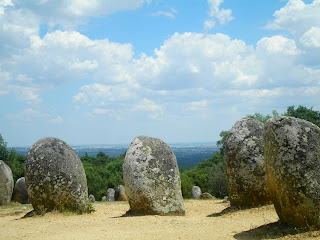
7,000 years old stone circle near Évora
At around 3am, the bar further up the beach came alive. As we were packing up and heading out five hours later, the place was just dying down. A group of friends, dressed in full club regalia, was ordering a nightcap and a round of coffee at the café next door. I’ve never learned to keep up with the parties of the Latin world and, listening to their still-energetic laughter, I felt more certain than ever that I never will.

Mackenzie and I in Sevilla
In July, my parents and my sister came for a 9-day visit. It was wonderful to see them, to introduce them to our friends and show them around our town; having them here relieved the homesickness I hadn’t even realized I had. They rented a car and the five of us crammed into it nearly every day, racing off to various corners of Iberia. We spent a day touring castles within a 30-mile radius of Zafra, an endeavor which, thanks to the glamour-hungry nobility of medieval of medieval Extremadura, can amount to a very, very long day. We spent a day in Sevilla, sipping sangria beneath the Giralda and visiting Columbus’ tomb in the jaw-dropping Gothic cathedral. We lie on a beach in Huelva and sat drinking beer in the waves. We saw the Roman amphitheater and art museum in Merida and the ancient and pristine village of Monsaraz in the hills of eastern Portugal.

Mom, Mackenzie, and Dad at the Roman temple in Évora
In Évora, otherwise an elegant and cheerful Portuguese Roman city, we toured a chapel decorated entirely with human bones. In the 16th century, a real buzzkill of a monk decided his brothers weren’t giving enough thought to their own mortality. So he dug up 5000 skeletons from a few dozen churchyards and dismantled them, arranging their skulls in rows on the walls, lining the support beams of the room with femurs, humeri, and ribs. Apparently concerned that the message wasn’t clear enough, he left two of the skeletons, one of which had belonged to a small child, in tact and fully dressed in rotting tunics, hanging on chains from the ceiling. The entryway is engraved with the warning “Nós ossos que aquí estamos, pelos vossos esperamos.” Assuredly the most morbid tongue-twister ever conceived, it translates roughly as “We bones here lie, awaiting yours.” I'll spare you the photos.

The Rock of gibraltar
We passed one appropriately cool and rainy afternoon in Gibraltar, one of the last little holdouts of the British empire. It’s a surreal place, utterly unnatural. The territory is cut off from Spain by a runway, so before we entered, we had to stand behind a barrier as two planes landed not 200 feet from us. After crossing the runway (yes, walking on foot across a runway) we entered a town that does, indeed, look like a British tourist trap, save for the palm trees, Spanish skin, and bilingual restaurant signs. We ate fish and chips and drank dark beer at an oak-walled pub. We walked through tacky gift shops peddling royal wedding memorabilia and red phone booth key chains and visited an Anglican church decorated with an oddly aggressive nautical theme and countless Union Jacks. 

Mackenzie in Gibraltar (UK!)
On our way up to the Rock, we lost our way in what I suppose I’d have to call “real Gibraltar,” a disastrous maze of broken streets where trash spills into the sidewalks and the colonial language cedes ground to the native. No Kate and William commemorative dishes here. Just as we’re beginning to feel sufficiently disoriented, we start seeing the monkeys. They’re just right there, hanging out on the walls, watching you climb as they clean each other’s fur. They’re sort of the national symbol of this teeny little country, even occupying a spot on the money. There’s a legend that claims that as long as they’re around, the British will keep their hold on Gibraltar. It’s such an ingrained idea that Winston Churchill actually restocked the place with monkeys when their numbers appeared to be dwindling. As we climb through their ranks, the low mountains of Africa come into view from across the strait. 

One of the barbary macaques of the Rock.
While the family was here we moved out of our apartment and into the one above it. It’s a brighter, more comfortable place with a terrace that overlooks two ancient churches and a sea of terra cotta rooftops. Our first night here we threw a party for my family and our Spanish and German friends, and after a few drinks, everyone on the terrace somehow spoke the same language. 

With the McDermotts back in America, we felt the travel bug again and at the end of June we loaded our bags back into Carlos’ van, this time setting off north to France. This journey is a story of its own, and I’ll tell it soon. For now, suffice it to say that I am a seasoned camper and, should I ever have to live as a vagrant, I’ve got at least a basic education in gypsy survival. 

We had barely returned from France when our friend Remedios asked us to join her on a three-day trip to Almería, the southeastern coastal desert where many of the spaghetti westerns, including The Good, the Bad, and the Ugly, were filmed. Couldn’t say no to that one, so we loaded up the tent again. We went to Cabo de Gata, a nature reserve dotted with villages in the style of northern Africa and frequented by a rather Californian crowd. Dozens of little coves are carved into the coastline, creating small, isolated beaches and warm little bays. We snorkeled around the reefs just offshore and followed the little jellyfish around (we watched quite a few people pay the price for that ill-advised activity and counted ourselves lucky). Every night after the sun went down, Reme curled up in the backseat of her station wagon and we set up our tent right on the beach and fell asleep to the sound of the sea. On one particularly beautiful night, we laid out our sleeping bags under the stars and were just drifting off when something that looked startlingly like a scorpion crawled across Levi’s foot. We set up the tent faster than we ever had. 


Katie at the Roman Theater
Not long after returning from Almería, my friend Katie paid us a visit. I had been feeling so lonely for my IU loves, and having her here was exactly what I needed. Levi graciously offered to teach my classes for me for the whole week, so Katie and I were able to spend day after day lying around on the terrace and at the pool, drinking the questionable homemade cocktails we always threw together in college and catching up on each other’s lives. I don’t have any close girlfriends in Spain, and I can only ask Levi to participate in so much female-specific tête-à-tête. Thus, plenty of reminiscing and chattering ensued. It was fantastic week.

One night during Katie’s visit, a young couple we’ve gotten to know this summer invited to Mérida for the annual Roman theater festival. We sat on the rocky benches of the thousand-year-old amphitheater and watched a beautiful rendition of Antigone. It was one of the most memorable experiences I've had in Spain.

Antigone at the Roman Theater
After Katie left, we had a sudden influx of classes. A disconcerting number of people failed their oral exam at the language school in the spring, and come August everyone was suddenly and frantically preparing for the September make-up exam. Now the exams are over and the school year has started, and we find ourselves in that strange period between the beginning of the academic year and the end of the fair. This fair (described here) is the most important event of the year in Zafra, and for the month before it, no one bothers to do anything at all. Classes are relaxed to the point of nominal and nothing beyond the absolutely obligatory is even suggested. When the fair opens in the last week of September, classes stop, work stops, life in general stops. So until October, when the fair closes down and we both get back to work, it’s a quiet season for us. 

Faced with all this down time, we finally started dealing with the issue of what to do with ourselves when our jobs end in June. We had been talking about southeast Asia for a while, so Levi sent an e-mail to a friend of a friend who operates an English school in southern Thailand. We researched the place, and it sounds perfect. We both applied and will interview in the next few days. If all goes as hoped, we’ll be on our way in less than a year from now! Always over-eager about things like this, I’ve started studying the Thai language. This script is difficult and the tones are still escaping me, but I’m feeling pretty good about it. I’ve also been brushing up on my more academic Spanish by reading complicated pieces of literature, so my brain is awash with foreign syllables and baffling idioms. Three weeks remain of the lazy Spanish life, cooking elaborate meals simply because I’ve got the time, watching all five seasons of The Wire and, whenever the languor momentarily subsides, keeping this thing up to date. Hasta pronto, สวัสดี