Our apartment is interior, which in Spanish architectural conventions means that its windows open to an interior rectangular patio surrounded by other apartments. In the summer, when our patio neighbors' windows are open, you can hear the life of dozens of the homes of this working-class barrio--telenovela stars monologuing, talk show hosts screaming at each other through the static of ancient radios, children laughing, babies wailing, cats meowing from windowsills, a lapdog downstairs expressing its impotent rage, the construction workers on the ground floor singing while they hammer and drill.
We 're right near a corner of the patio, and just caddy-corner from the apartment of a woman in her fifties. She's South American, by her accent, although she's been here long enough that her grown children speak with the lisps and smooth cadence of Madrid. Her window to the patio is in her kitchen, so around meal times, we get a full blast of her volatile emotional life. The family is in the living room behind her as she prepares lunch, chopping garlic and onions with furious whacks of her knives on the cutting board. She throws down pots and pans and slams shut cabinet doors, all the while screaming at her family in the next room. They don't come see her enough, they don't care enough about her, they say mean things to her and never take to her advice. She's a good woman and a good mother, goddammit, and they should be better children.
The kids respond the same way every meal: we're always here, Mom, we call every day, we eat nearly every meal with you. But there's no calming her once she's in her stride.
After the meal, she's back in the kitchen to do the dishes. Apparently the heat of the stove, or possibly that of her fervor, has become unbearable, because at this point she often whips off her shirt and does the washing up bare-chested, her naked top half in full view of anyone who cares to look into the patio. Free from her elastic bonds, she really lets loose, bellowing out the window about her terrible children, about how her shows are all jumping the shark; the bills, the rent, the government, the nagging phone calls from various parties--nothing in her world is safe from her braless recriminations.
Dishes done, she retires into the more soundproof recesses of her flat (presumably after donning her discarded shirt) and we enjoy a few hours of the relative quiet of jackhammers and yapping yorkies.
Tuesday, September 16, 2014


Monday, August 11, 2014
marsella
Spanish summer--hot, lazy, and blissfully relaxed. We didn't manage to find any work after the first week of June, so Levi and I have been bumming around, living off the savings and taking it very easy in our neighborhood. We allowed ourselves one luxury, a three-day trip to Marseilles, a gorgeous city on the Mediterranean coast of France.
Levi participates in several online photography forums, and through one of them had connected with a French photographer from Marseille. A few months back, he and his wife came to Madrid for a long weekend, and we met up with them. They invited us to come visit, even offering a place to stay. I'd been through Marseilles for a couple of days on a backpacking trip when I first came to Europe in 2010, but Levi had never visited anywhere in that region. It's the most photogenic city I can imagine, a street photographer's dream. So we found a cheap flight and planned a trip for July.
We arrive, assuming Mathieu and his wife Yolande would offer us a bedroom and some sightseeing advice. In fact, when he picks us up from the airport, Mathieu tells us that his neighbors were away on vacation and that we would be staying in their empty house. It's a two-story row house in a beautiful neighborhood outside of the city center. It was built by Napoloean's troops during his urbanization efforts in the previously rural area. There's a balcony and a jacuzzi tub and an espresso machine and a cuddly black cat. It's a far cushier vacation spot than we could have hoped for.
After a shower and some coffee, Mathieu, who is enjoying the unencumbered summer afforded to teachers, drives us on a tour of his Marseilles. He came here from Vietnam as a small child, and aside from some time in Paris, has lived in the city his whole life. His children, now grown up and moved out, were raised here. He knows the place better than any guide book that exists. He takes us outside of the touristy (albeit stunning) center an into the surprisingly old-fashioned fishing villages on the outskirts.
Marseilles in a collection of villages that have been gradually incorporated as the city grew, but have managed to maintain their unique identities and small-town feels. The ones on the coast are tiny clusters of tiny houses built around harbors crammed with fishing boats. Some are humble to the point of reminding me of Thailand with their corrugated metal roofs and clearly homemade boats, and some are plus little hideaways with mini pleasure cruisers and restaurants offering €70 bowls of bouillabaisse. Mathieu tells us that even the most modest of the houses in these villages would go for millions, were they ever to be sold, but the owners almost exclusively hand them down to family. It used to be that waterfront property was a simple fisherman's occupational necessity, but now it's a coveted spot for the glamorous, corrugated metal and all.
Mathieu and his wife invite us to their house that night for a little dinner party. I don't understand a word of French, but thankfully there are English and Spanish speakers in the group, and we have a lovely time. French rosé, champagne, eggplant souffle, stuffed tomatoes, fresh salad and cream pastries...Yolande is an incredible cook; I think I could probably live and die at this table.
The next day, Mathieu has photography plans for Levi. He's taking him to the development lab where he has his high-quality prints made for expos. Levi's thrilled but it's not likely to be entertaining to me, so Mathieu hands me off to Genevieve, an old friend of his we met at dinner the night before. She's a retired teacher and a huge Marseilles history buff. She leads me on a two hour walking tour around the city's central port, pointing out important buildings and recounting their histories.
She knows construction dates, architects, and anecdotes. She shows me the area where the Greeks built their agora when they settled here 2600 years ago, the Roman-constructed port, and the Napoleonic fortress. We stop for fresh-squeezed orange juice at a cafe in a modern-art structure overlooking the sea.
We meet up with Mathieu, Yolande, and Levi at a Vietnamese restaurant in the neighborhood, then get ice cream at a place that makes it by hand from fresh fruit. We end the day with dinner in Mathieu and Yolande's back yard.
On our final day, Mathieu brings us out to Cassis, a ritzy coastal town near Marseilles on the calanques, a series of rocky coves that offer gorgeous beach and boating space on the Mediterranean. The place is the archetypal Riviera town: touristy, overpriced, over crowded, but undeniably beautiful. We walk around for a couple hours and have a picnic in a park before heading back to Marseilles.
That night Mattieu brings us to his favorite pizza truck. Marseilles, with its large Italian immigrant population, claims to be the home of the world's first pizza trucks. The pizza in Spain can't be called anything better than edible, so when we caught whiff of the Napoli pizza trucks that dot the city, we decided we could have one non-French meal. We bring several and brought them back to the home of Mathieu and Yolande's daughter Emma and her boyfriend Xavier. We spend the evening eating far too much of this delicious pizza (tasted like home) and drinking wine.
It was a perfect getaway. It's a fantastic city and, more importantly, Mathieu and his family and friends showed us unsurpassable hospitality. Lovely weekend.
Photos, unless otherwise stated, are courtesy of my talented novio Levi Shand. See more of his work at levishand.com
 |
| A photo I took in 2010 of the city's central harbor |
 |
| The house across the way from ours, from the terrace |
We arrive, assuming Mathieu and his wife Yolande would offer us a bedroom and some sightseeing advice. In fact, when he picks us up from the airport, Mathieu tells us that his neighbors were away on vacation and that we would be staying in their empty house. It's a two-story row house in a beautiful neighborhood outside of the city center. It was built by Napoloean's troops during his urbanization efforts in the previously rural area. There's a balcony and a jacuzzi tub and an espresso machine and a cuddly black cat. It's a far cushier vacation spot than we could have hoped for.
After a shower and some coffee, Mathieu, who is enjoying the unencumbered summer afforded to teachers, drives us on a tour of his Marseilles. He came here from Vietnam as a small child, and aside from some time in Paris, has lived in the city his whole life. His children, now grown up and moved out, were raised here. He knows the place better than any guide book that exists. He takes us outside of the touristy (albeit stunning) center an into the surprisingly old-fashioned fishing villages on the outskirts.
 |
| One of the swankier of the harbor villages; that restaurant in the background is said to be one of the best in the region |
Mathieu and his wife invite us to their house that night for a little dinner party. I don't understand a word of French, but thankfully there are English and Spanish speakers in the group, and we have a lovely time. French rosé, champagne, eggplant souffle, stuffed tomatoes, fresh salad and cream pastries...Yolande is an incredible cook; I think I could probably live and die at this table.
 |
| Another shot from 2010, city center |
She knows construction dates, architects, and anecdotes. She shows me the area where the Greeks built their agora when they settled here 2600 years ago, the Roman-constructed port, and the Napoleonic fortress. We stop for fresh-squeezed orange juice at a cafe in a modern-art structure overlooking the sea.
We meet up with Mathieu, Yolande, and Levi at a Vietnamese restaurant in the neighborhood, then get ice cream at a place that makes it by hand from fresh fruit. We end the day with dinner in Mathieu and Yolande's back yard.
 |
| Levi and I at the calanques in Cassis |
On our final day, Mathieu brings us out to Cassis, a ritzy coastal town near Marseilles on the calanques, a series of rocky coves that offer gorgeous beach and boating space on the Mediterranean. The place is the archetypal Riviera town: touristy, overpriced, over crowded, but undeniably beautiful. We walk around for a couple hours and have a picnic in a park before heading back to Marseilles.
 |
| Levi in the ritzy tourist hub of Cassis (this one's mine, as evidenced by the questionable framing) |
 |
| Eating a slice while we wait for the whole pizzas..couldn't resist |
Photos, unless otherwise stated, are courtesy of my talented novio Levi Shand. See more of his work at levishand.com
Thursday, May 8, 2014
conflict
People in Madrid are plenty nice--they certainly don´t have the reputation of Parisians or New Yorkers for rudeness and aggression--but if they´re unhappy with you, they will make it damn clear. I´ve told the story of the furious upbraiding of a whole train car for refusing to give up a seat to an old woman, and over the past few weeks I´ve witnessed several interactions that confirm my initial impression that Madrileños are not to be fucked with.
On the subway home from work one afternoon, a middle-aged guy and his elderly father got onto the train. The father is decked out in all the trappings of the tourist--an open map, walking shoes, and a camera case strapped (rather unwisely, I thought) around his waist. The train was a bit crowded and they found themselves pushed up next to a couple a grungy-looking types, two guys in torn jeans and dirty t-shirts. The father was looking at his map, but the son, suspicious of the neighbors from the start, kept watch over the situation out of the corner of his eye. A couple of stops down the line, an unwelcome hand is on the camera case, and the son is screaming. ´´Get your filthy hand away from my father´s camera! Thief! Thief! There´s a thief on the metro!´´ The guy´s face gives him away--he clearly had designs on the camera-- and his friend is throwing him under the bus, putting space between them, pretending to be absorbed in his iPhone. The son´s still yelling. ´´Where the hell is security? Someone call security! Thief!´´ He´s shoving the would-be perpetrator against the wall when other travelers finally get involved, entreating him to relax before this gets ugly. When he and his father disembark, he stands at the open doors of the car, yelling to everyone getting on ´´Watch your things, there´s a thief on this train!´´ while the failed criminals disappear into the crowd.
I teach private classes in a fancy neighborhood full of fur coats and BMWs where people literally look down their noses at you. There´s a little shop near the metro I take home and I duck in for some snacks. A woman in full mink walking on a mahogany cane enters the store, carrying a large, open bag of sunflower seeds. She plops it down on the counter and says politely, ´´I would like to return this.´´ The shop attendant, a girl about my age, looks confused. ´´But you opened it.´´ ´´Well yes, how else would I know if I like them? They´re not as good as the ones I usually buy and I want to exchange them.´´ The shop girl, clearly not endowed with immense patience, explains in no uncertain terms that this is patently ridiculous. The lady can´t believe what she´s hearing--her manners rapidly erode as she spirals into a ever-louder rampage on the deterioration of customer service in this country. They both look at me, each expecting me to support her case, so I run away.
Sometimes it´s obnoxious and absurd, but there is a certain admirable boldness in it. So many people here are perfectly willing to cause a scene, no matter how large or small the issue. I prefer to go about my day in peace, generally not screaming at anyone... but I must admit I enjoy the show.
On the subway home from work one afternoon, a middle-aged guy and his elderly father got onto the train. The father is decked out in all the trappings of the tourist--an open map, walking shoes, and a camera case strapped (rather unwisely, I thought) around his waist. The train was a bit crowded and they found themselves pushed up next to a couple a grungy-looking types, two guys in torn jeans and dirty t-shirts. The father was looking at his map, but the son, suspicious of the neighbors from the start, kept watch over the situation out of the corner of his eye. A couple of stops down the line, an unwelcome hand is on the camera case, and the son is screaming. ´´Get your filthy hand away from my father´s camera! Thief! Thief! There´s a thief on the metro!´´ The guy´s face gives him away--he clearly had designs on the camera-- and his friend is throwing him under the bus, putting space between them, pretending to be absorbed in his iPhone. The son´s still yelling. ´´Where the hell is security? Someone call security! Thief!´´ He´s shoving the would-be perpetrator against the wall when other travelers finally get involved, entreating him to relax before this gets ugly. When he and his father disembark, he stands at the open doors of the car, yelling to everyone getting on ´´Watch your things, there´s a thief on this train!´´ while the failed criminals disappear into the crowd.
I teach private classes in a fancy neighborhood full of fur coats and BMWs where people literally look down their noses at you. There´s a little shop near the metro I take home and I duck in for some snacks. A woman in full mink walking on a mahogany cane enters the store, carrying a large, open bag of sunflower seeds. She plops it down on the counter and says politely, ´´I would like to return this.´´ The shop attendant, a girl about my age, looks confused. ´´But you opened it.´´ ´´Well yes, how else would I know if I like them? They´re not as good as the ones I usually buy and I want to exchange them.´´ The shop girl, clearly not endowed with immense patience, explains in no uncertain terms that this is patently ridiculous. The lady can´t believe what she´s hearing--her manners rapidly erode as she spirals into a ever-louder rampage on the deterioration of customer service in this country. They both look at me, each expecting me to support her case, so I run away.
Sometimes it´s obnoxious and absurd, but there is a certain admirable boldness in it. So many people here are perfectly willing to cause a scene, no matter how large or small the issue. I prefer to go about my day in peace, generally not screaming at anyone... but I must admit I enjoy the show.
Tuesday, April 8, 2014
granada
Levi and I hadn't been on a trip for a while, so when a coworker offered to drive us to Granada, a city in Andalucía where she regularly visits her boyfriend, we jumped at the opportunity. Granada was a stronghold of Arabic war until 1492, when the crown defeated the last Emir in Spain, bringing the whole country under Catholic Spanish rule. It's therefore a great architectural mix of Arabic and medieval Spanish. The Alhambra, the Arabic palace, still reigns over the city from a hill in the center. It's incredibly well-maintained and absolutely gorgeous. Great tapas, great weather, great walking through steep labyrinthian streets. I actually brought out the camera this time, so I'll let the pictures do the talking.
Wonderful weekend.
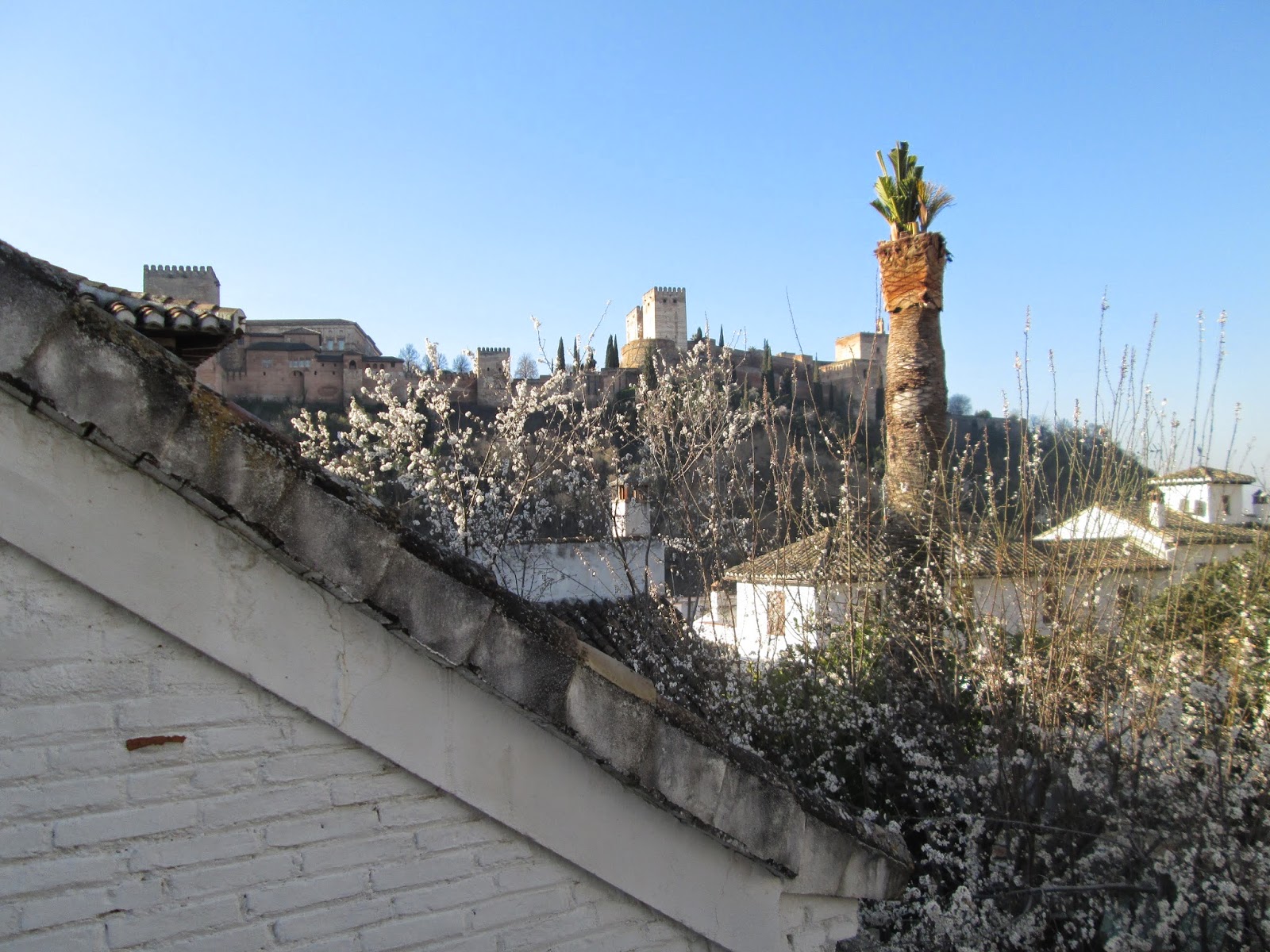 |
| The view from our balcony. We reserved a place for 30 euros a night, but upon arrival were informed that the heater had exploded, seriously damaging the apartment...Luckily, the owner had a friend who rents rooms and had one free. It was a serious upgrade. |
 |
| The Alhambra from our terrace. |
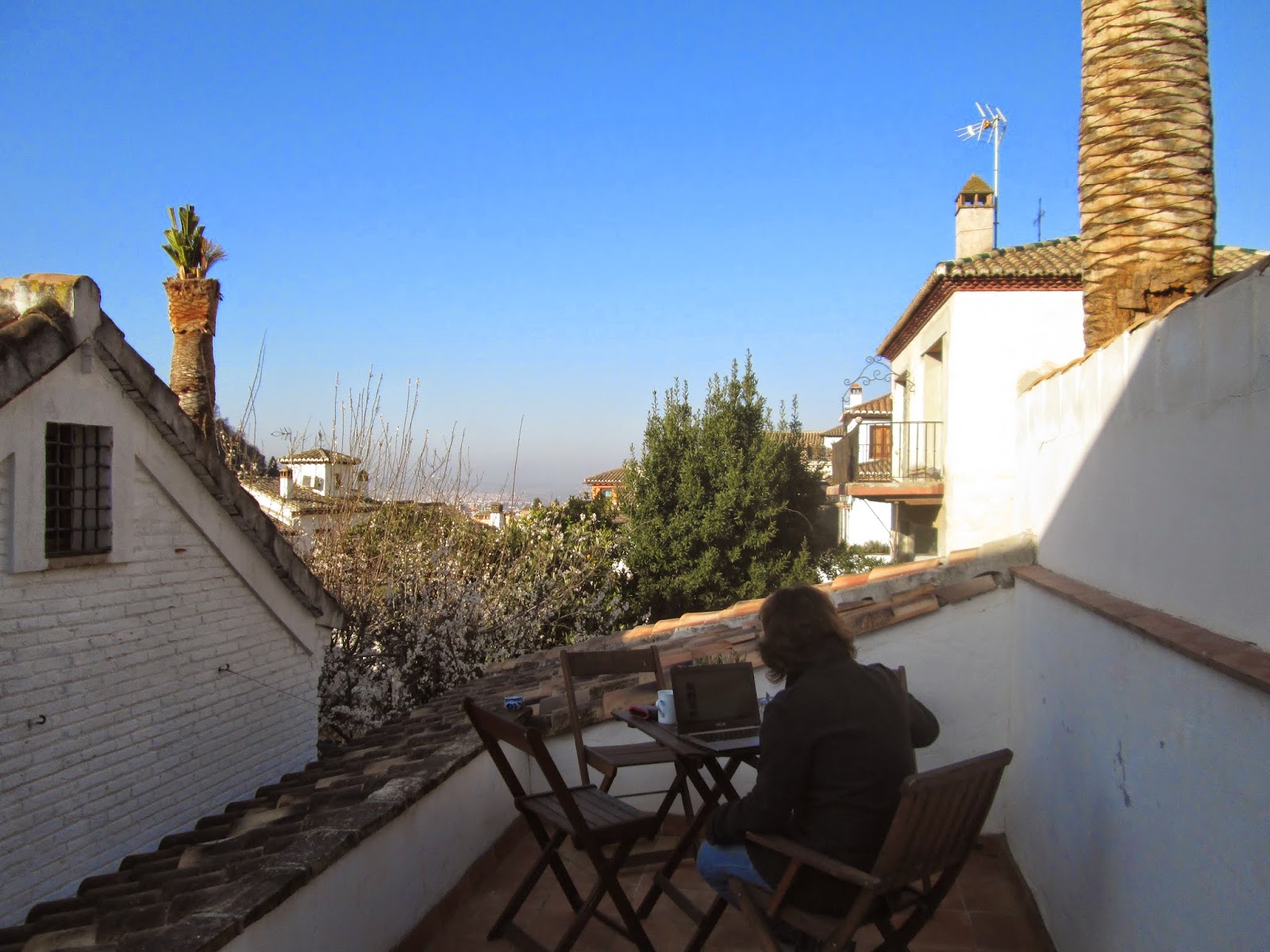 |
| Levi relaxing on the terrace in the morning. |
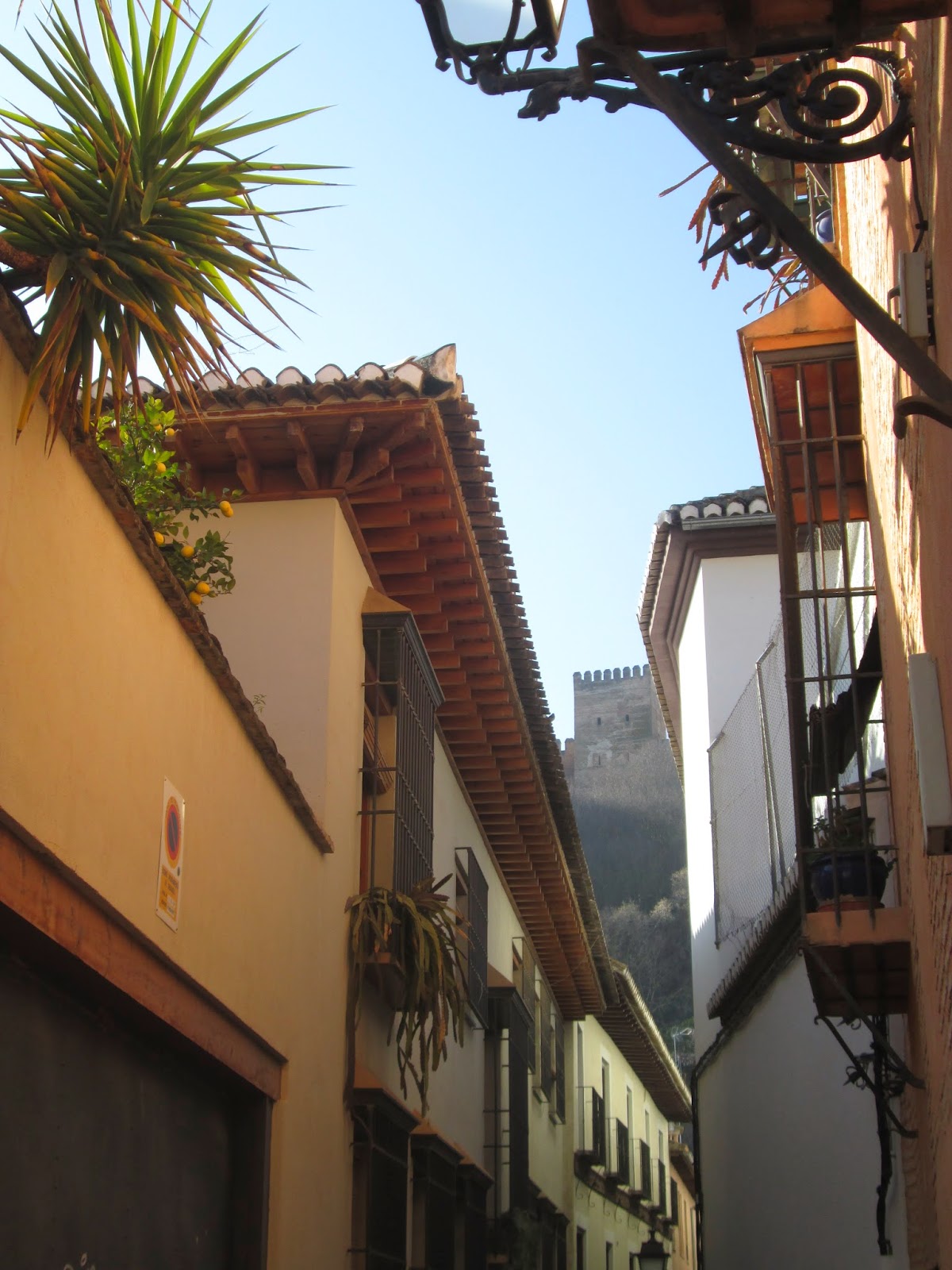 |
| Typical street in Albaycín, the old central neighborhood where we stayed. Alhambra peeking out. |
 |
| Zafra! |
 |
| Couldn't get enough of the views of the Alhambra. |
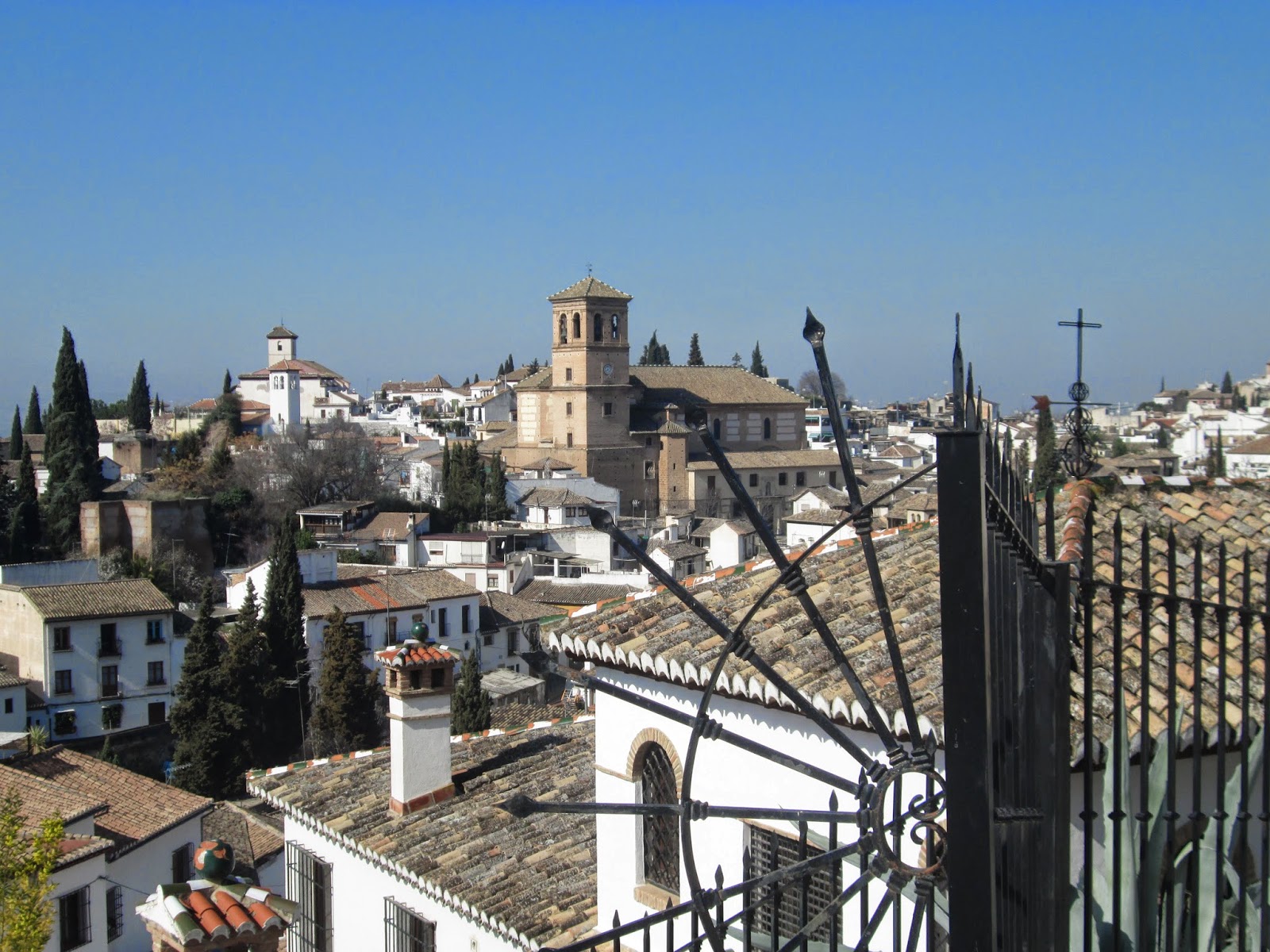 |
| View in Sacromonte, the Gyspy quarter of the city. |
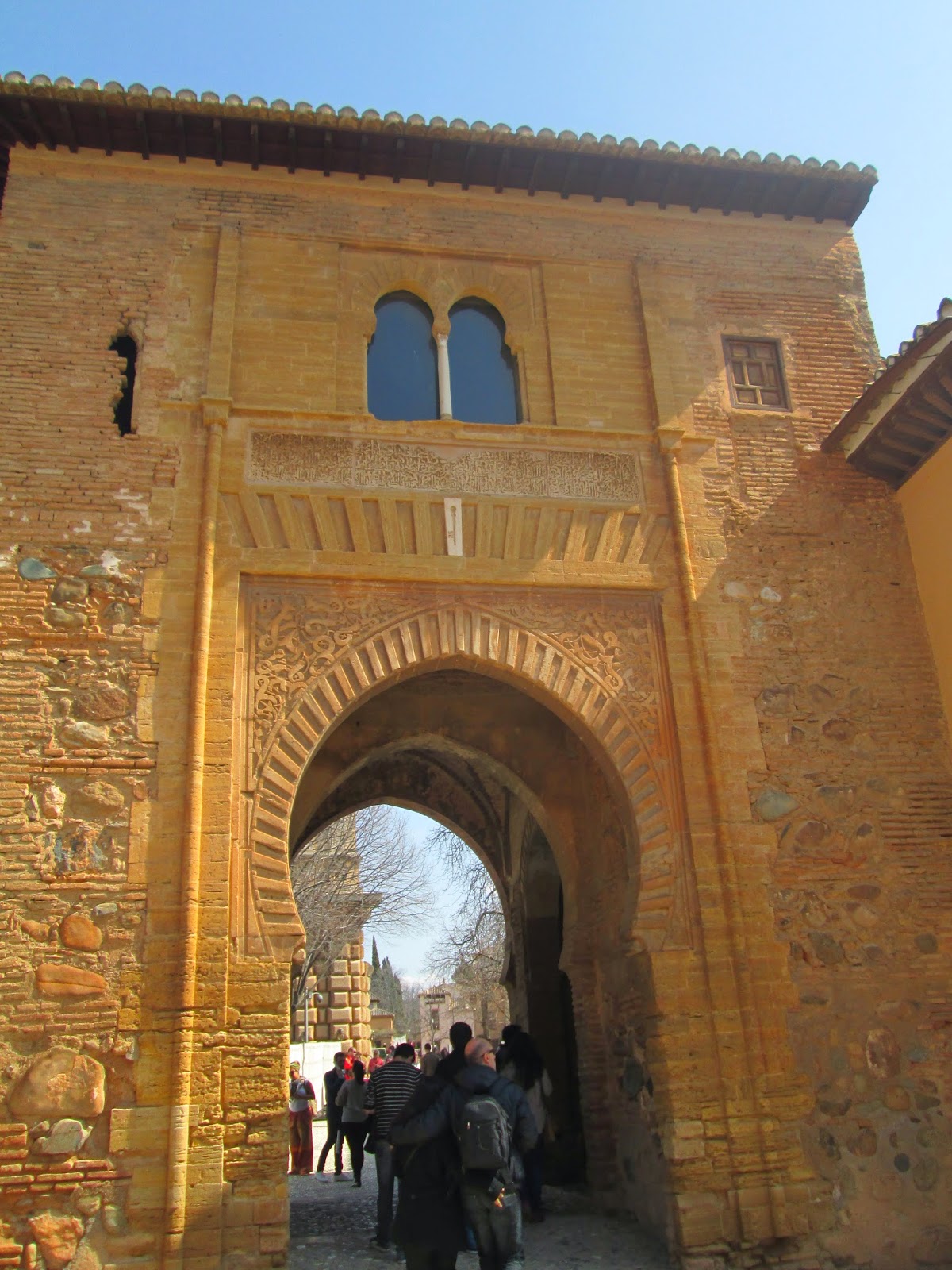 |
| Bad photo, but beautiful archway. In the Alhambra. |
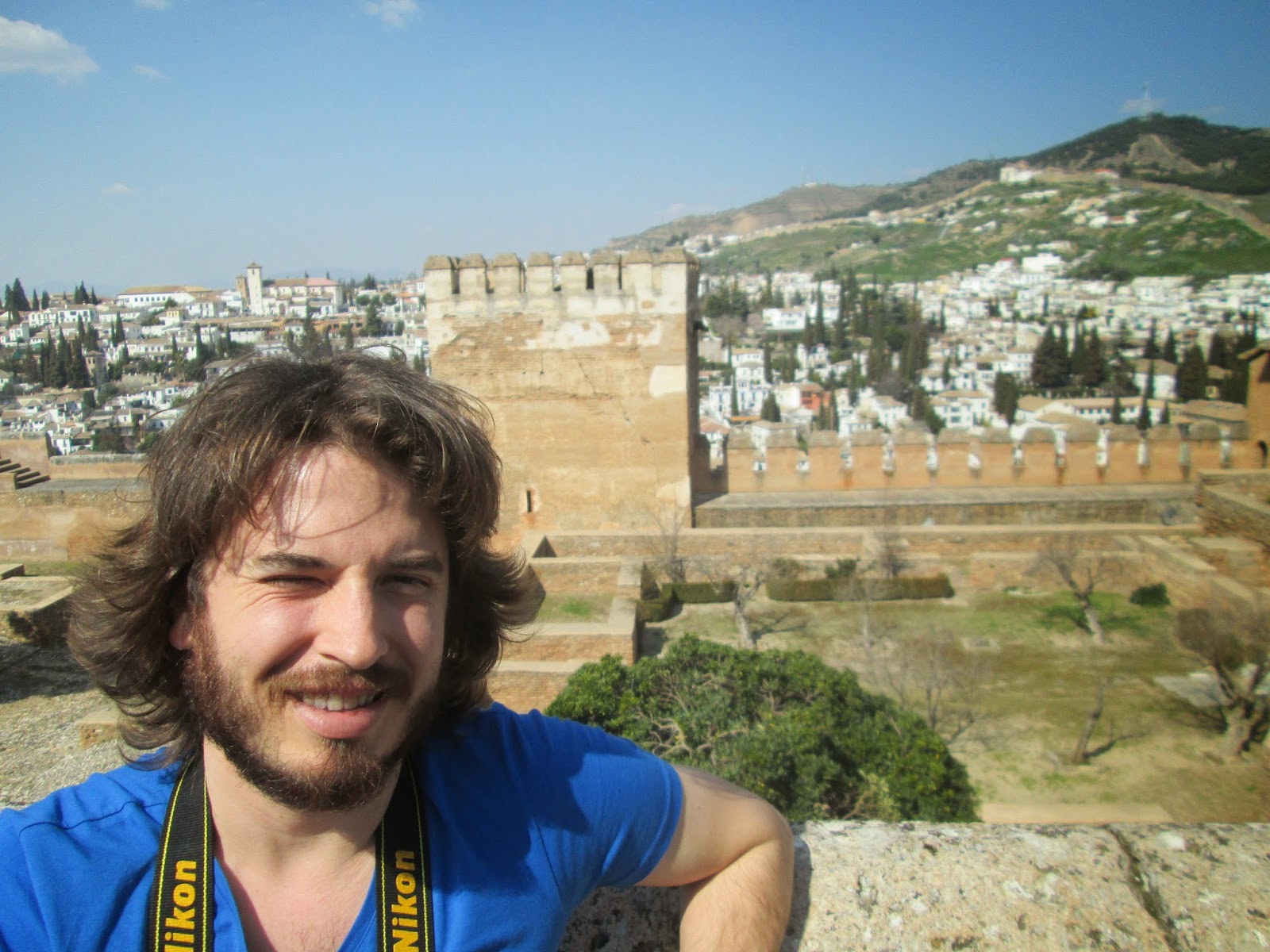 |
| Levi squinting in the Andalusian sun. In the Alhambra. |
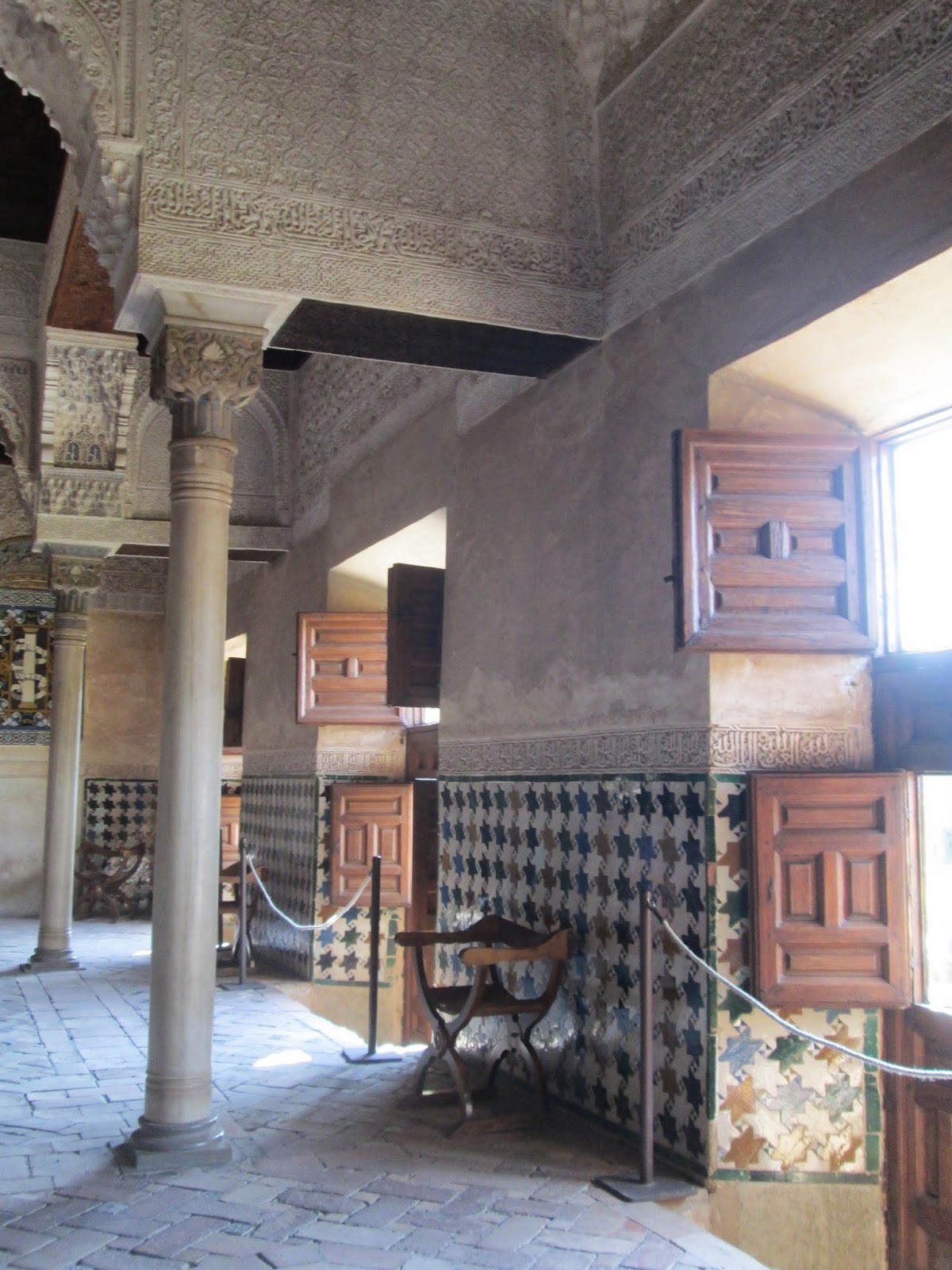 |
| In the Alhambra. |
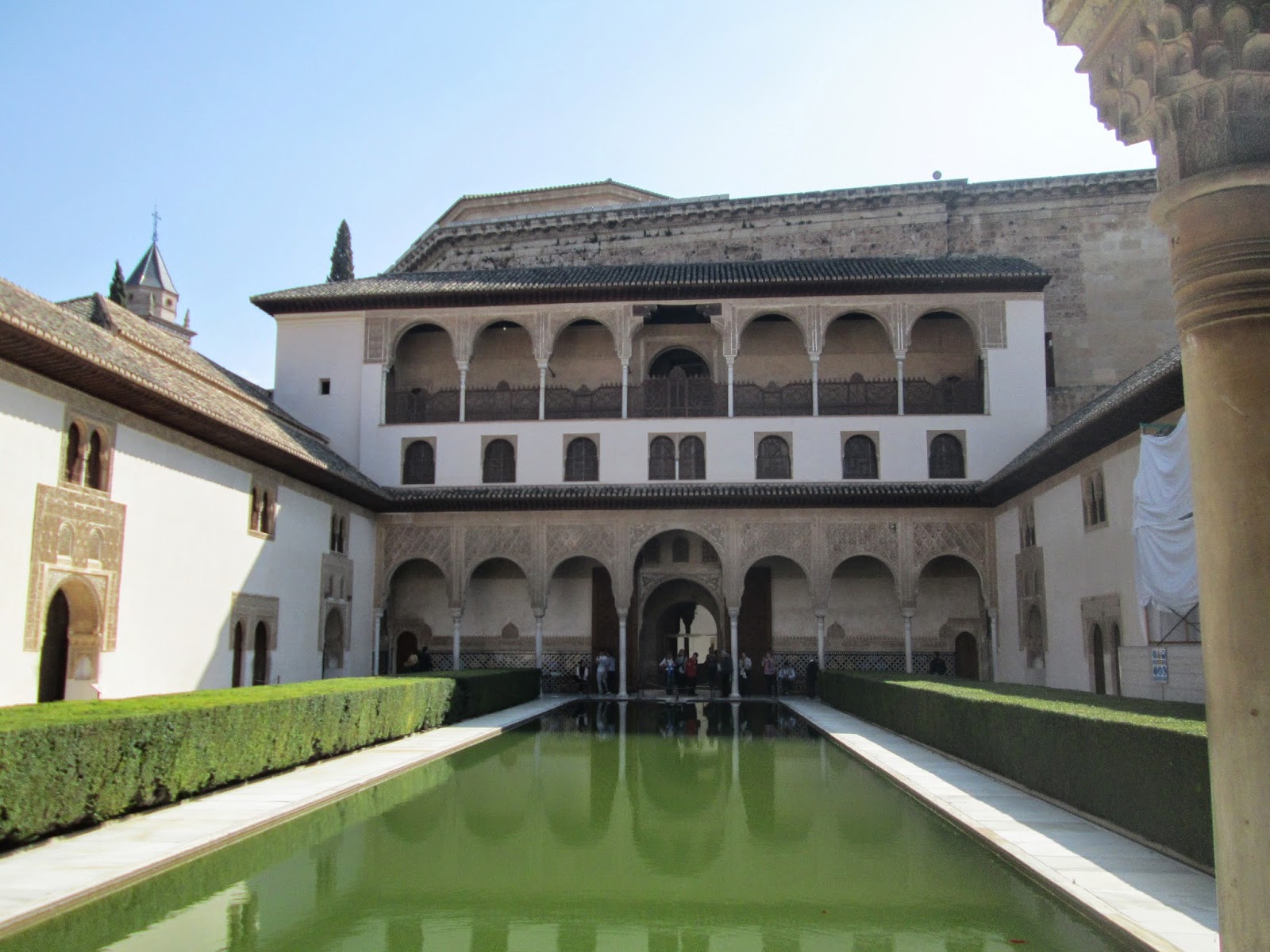 |
| Central patio, Alhambra. |
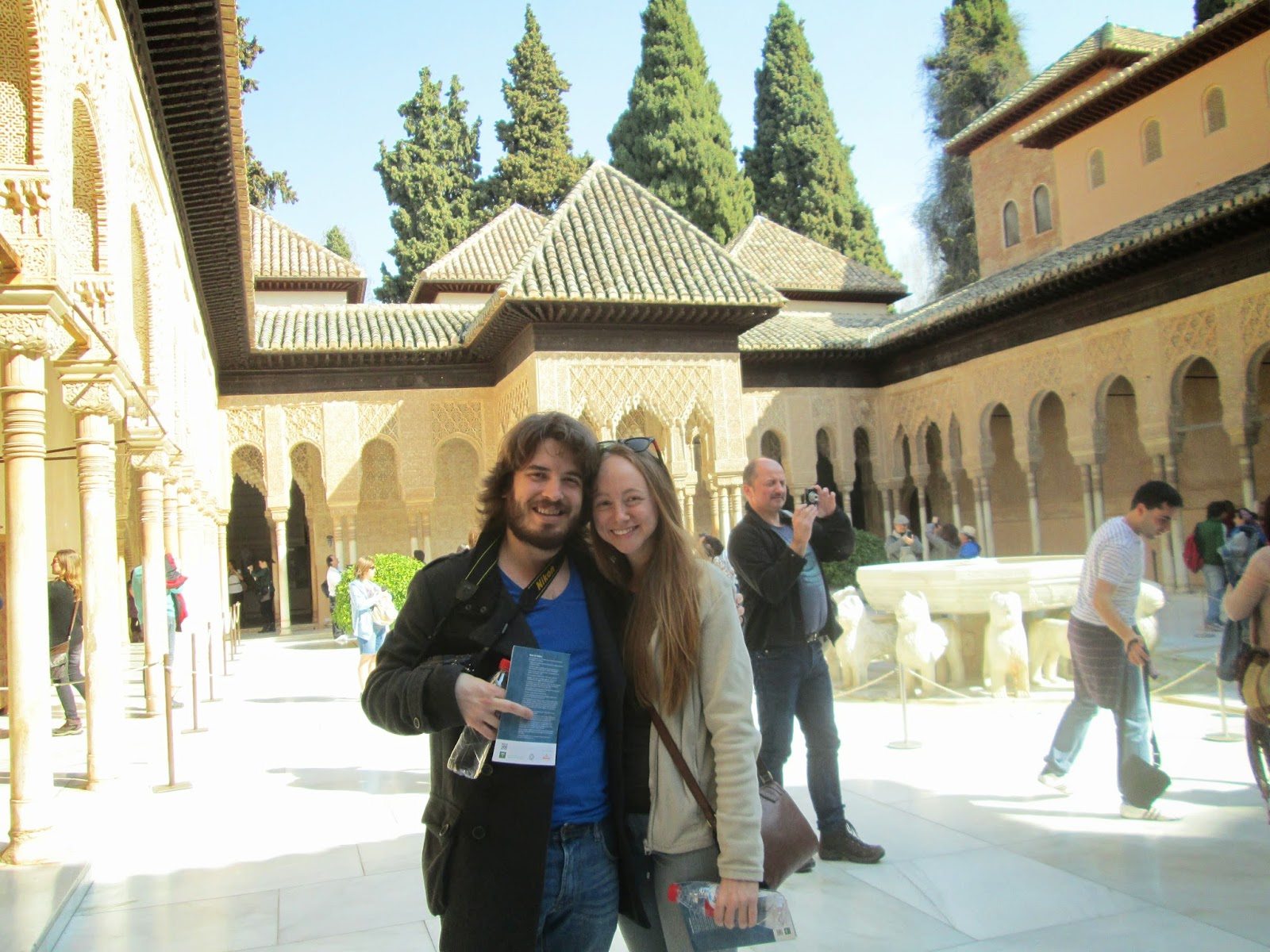 |
| Patio, Alhambra. |
 |
| Palace gardens, Alhambra. |
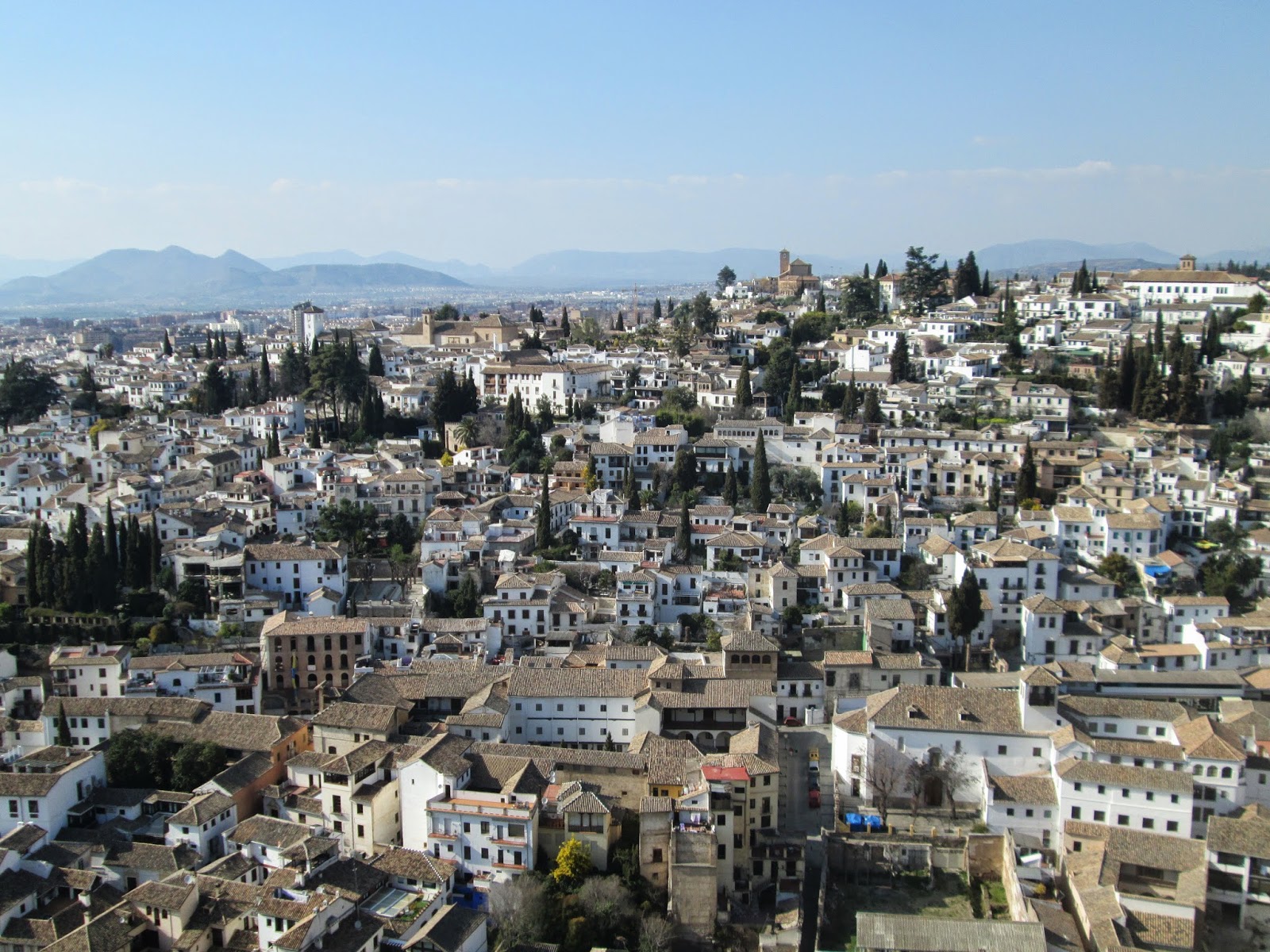 |
| View from the fortress of the Alhambra. |
 |
| In the fortress, the oldest part of the Alhambra. |
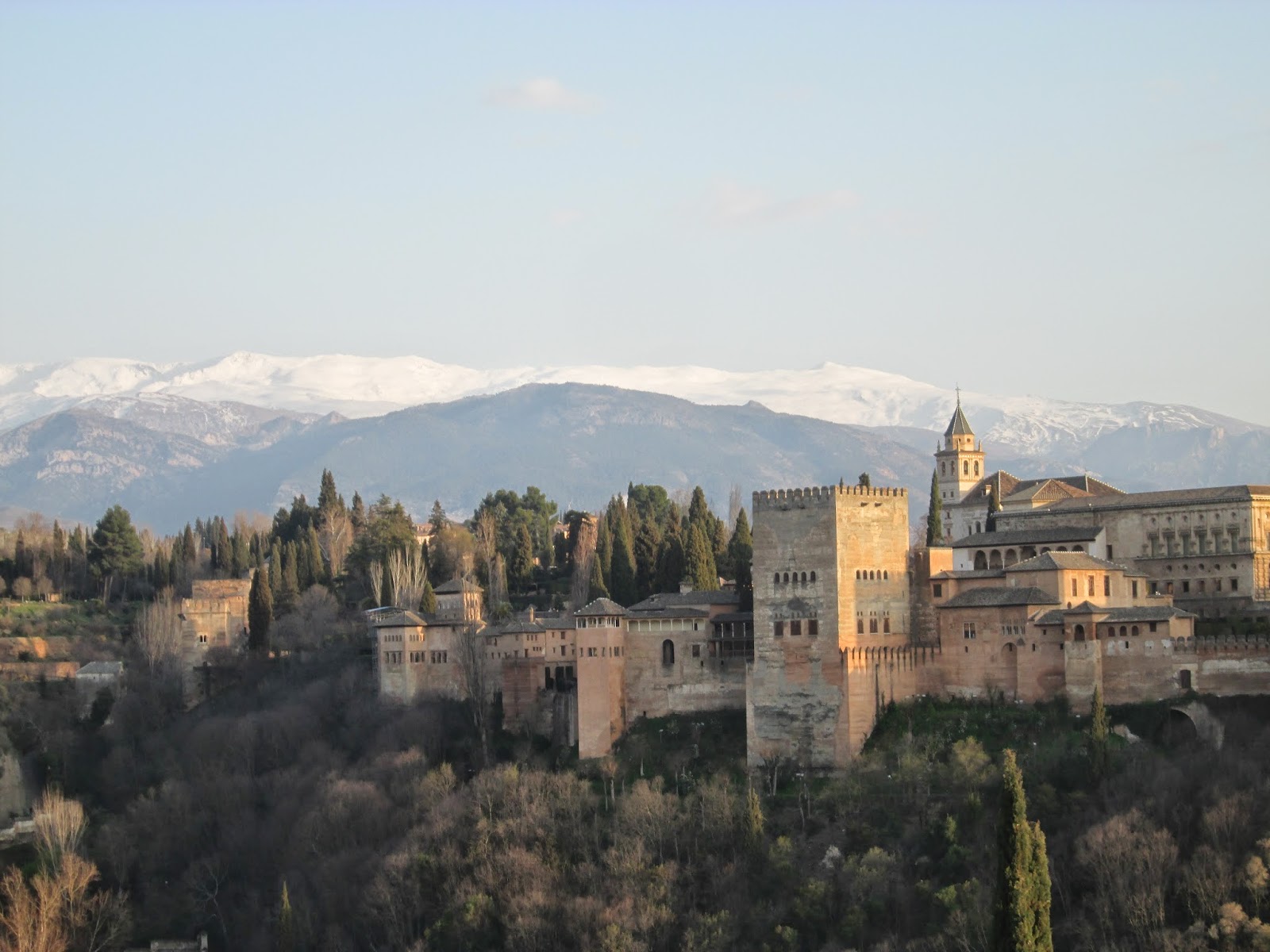 | |||
| Best view in the city. The Alhambra, foress, and Sierra Nevada in the distance. From the San Nicolás lookout. |
Wednesday, February 12, 2014
jóven
The elementary school where I teach is a bilingual school, meaning the students study English for several hours a week and also study two subjects in English, in our case Science and Art. This means I'm a Science teacher several times a week for my second-graders, which I love.
We're studying plant life, and today I had them drawing a flower and labeling its different parts. They're all working quietly when Ainhoa, a sassy, too-smart-for-her-own-good type, beckons me to her desk. She asks me, "Teacher, why do I have to learn these things? If I need to know about a flower I can just look it up online."
I froze.
This kid was born in 2006. She's never known a world without Facebook, YouTube, Wikipedia, or Twitter. She learned to google when she learned to read. She was barely forming sentences when the first iPhone came out. For her, all the information in the world is, and always has been, readily available whenever she needed it.
And as she stared up at my with critical, demanding eyes, I had to admit she had a point. Why does she need to know about the reproductive organs of a rose? I forgot all that immediately after high school and have never suffered as a result. In fact, when we started this unit in the book, I had to refresh my memory on the various parts of a flower.
I googled it.
But of course, the flower isn't the point. It doesn't really matter that Ainhoa remembers where the stamen is, or what function the sepals perform. The point is that she starts developing an understanding of the world around her, hopefully igniting an interest and a curiosity that will lead her to an intellectually fulfilling life. I don't want to fill her head with the loose facts she might encounter in a Google search; I want to teach her how to examine things thoughtfully and critically.
I offered her a kid-friendly version of this explanation, and it sufficed to turn her back to her drawing, but I don't think she really bought it. Maybe someday when she's a biologist hard at work in her lab, she'll think back on this day and realize that I was right, but until then she's probably just going to WhatsApp her friends about what a pain in the ass her teacher is.
We're studying plant life, and today I had them drawing a flower and labeling its different parts. They're all working quietly when Ainhoa, a sassy, too-smart-for-her-own-good type, beckons me to her desk. She asks me, "Teacher, why do I have to learn these things? If I need to know about a flower I can just look it up online."
I froze.
This kid was born in 2006. She's never known a world without Facebook, YouTube, Wikipedia, or Twitter. She learned to google when she learned to read. She was barely forming sentences when the first iPhone came out. For her, all the information in the world is, and always has been, readily available whenever she needed it.
And as she stared up at my with critical, demanding eyes, I had to admit she had a point. Why does she need to know about the reproductive organs of a rose? I forgot all that immediately after high school and have never suffered as a result. In fact, when we started this unit in the book, I had to refresh my memory on the various parts of a flower.
I googled it.
But of course, the flower isn't the point. It doesn't really matter that Ainhoa remembers where the stamen is, or what function the sepals perform. The point is that she starts developing an understanding of the world around her, hopefully igniting an interest and a curiosity that will lead her to an intellectually fulfilling life. I don't want to fill her head with the loose facts she might encounter in a Google search; I want to teach her how to examine things thoughtfully and critically.
I offered her a kid-friendly version of this explanation, and it sufficed to turn her back to her drawing, but I don't think she really bought it. Maybe someday when she's a biologist hard at work in her lab, she'll think back on this day and realize that I was right, but until then she's probably just going to WhatsApp her friends about what a pain in the ass her teacher is.
Sunday, February 9, 2014
civil
It's a general rule on the Madrid metro (and on most public transport in the world, from what I've seen) that young, healthy people should give up their seats to people who need it more. Usually, when anyone over sixty gets on the train, a couple people jump up and offer their seat. On the more crowded lines at rush hour, however, getting a seat is such a miracle that people are hesitant to surrender it, regardless of the age or physical well-being of incoming passengers.
A few days ago I'm standing, squeezed shoulder to shoulder on a downtown-bound subway train when an elderly woman with a walker climbs onboard. She looks around hopefully at the lucky ones in the seats, all of whom appear suddenly to have very important things to do on their cell phones or in the bottoms of their purses.
A guy leaning against a wall offers this second-best position to the lady, and after helping her get secure enough to withstand the jerky stop-and-go motion, he turns on the sitters.
"Look at all of these shameless jerks, bowing their heads like they don't see her," he practically spits at the crowd, who are now addressing truly urgent iPhone crises and launching search expeditions in murky depths of their handbags. "It's disgusting, it really is. All a bunch of assholes. People these days have no manners. Fuck."
Thoroughly shamed, most of them choose to hold their ground at this point, apparently deciding that they'd come too far to turn back, but one guy (possibly because he doesn't have a smartphone to hide behind) stands up and, blushing, offers up his seat. The lady thanks him profusely, clearly a touch embarrassed by her uninvited knight in shining armor. Our hero, however, can only triumphantly mutter, "finally."
A few days ago I'm standing, squeezed shoulder to shoulder on a downtown-bound subway train when an elderly woman with a walker climbs onboard. She looks around hopefully at the lucky ones in the seats, all of whom appear suddenly to have very important things to do on their cell phones or in the bottoms of their purses.
A guy leaning against a wall offers this second-best position to the lady, and after helping her get secure enough to withstand the jerky stop-and-go motion, he turns on the sitters.
"Look at all of these shameless jerks, bowing their heads like they don't see her," he practically spits at the crowd, who are now addressing truly urgent iPhone crises and launching search expeditions in murky depths of their handbags. "It's disgusting, it really is. All a bunch of assholes. People these days have no manners. Fuck."
Thoroughly shamed, most of them choose to hold their ground at this point, apparently deciding that they'd come too far to turn back, but one guy (possibly because he doesn't have a smartphone to hide behind) stands up and, blushing, offers up his seat. The lady thanks him profusely, clearly a touch embarrassed by her uninvited knight in shining armor. Our hero, however, can only triumphantly mutter, "finally."
Wednesday, January 15, 2014
parada
The elementary school where I work four days a week is in Perales del Rio, a tiny bedroom community outside of a suburb of Madrid. If I were to hop in a car, it would take me about fifteen minutes to get from my downtown apartment to my school. Since I don't have a car, I spend a little under an hour in commute each way in a foot-subway-bus combo. At first it seemed awful, but I got used to it and eventually came to actually enjoy it. It's a good opportunity to get some reading in,and occasionally I cross paths with some interesting people.
As I approached the bus stop in Perales the other day, a woman of seventy or so, looking rather agitated, began throwing questions at me before I had even stopped walking. She´d been waiting for this damned bus for nearly half an hour, she said, and was losing patience. She supported herself unsteadily on a garled wooden cane and was missing several teeth. Her clothes were neat but simple. I told her the bus would arrive in about ten minutes.
´I remember when this area was nothing but open field,´ she says, gesturing to the little village, whose architecture and young trees indicate no more than twenty years. ´The city was smaller then.´ She says the same thing has happened to downtown Madrid, where she has spent her entire life. ´There was a public hospital on Atocha Street, right by my house.´ She´s wistful. ´Now they´ve moved it to the middle of nowhere.´ Everything in Madrid´s city center has been slowly migrating into the peripheral areas, she laments. ´I´d never leave downtown if it were up to me. But a good friend lives way out here and doesn´t like to come into the city. I didn´t have kids because I didn´t want to complicate my life, and now my friends complicate it for me. But it´s nice to see old friends.´
It´s not all reminiscing, though. Although she remembers the city as smaller, maybe more quaint, she spent her youth under an oppressive dictatorship. ´I saw people starving. Dying of hunger in the streets. Sick and dying.´ Spain´s fascist regime, which lasted forty years and fell only upon the death of leader Francisco Franco in 1975, was initially intensely isolationist, cutting off international trade and further stifiling an economy already ravaged by civil war. In the latter half of Franco´s reign, the economy grew, but this growth was enjoyed largely by the upper classes. ´You weren´t yet in the world, honey, but believe me, it was hard.´
A couple of years ago Levi and I had lunch with an retired neighbor in Zafra, a stately, sweatervest sort of fellow with a modest but very comfortable downtown flat. He showed us the Franco-era pistol he keeps in a velvet lined box and his collection of Franco coins, lamenting that those were better times, before the euro, before these liberal Popes and progressive governments, when people had money and stability and Spanish culture was at its most glorious heights. Those were the days.
As I approached the bus stop in Perales the other day, a woman of seventy or so, looking rather agitated, began throwing questions at me before I had even stopped walking. She´d been waiting for this damned bus for nearly half an hour, she said, and was losing patience. She supported herself unsteadily on a garled wooden cane and was missing several teeth. Her clothes were neat but simple. I told her the bus would arrive in about ten minutes.
´I remember when this area was nothing but open field,´ she says, gesturing to the little village, whose architecture and young trees indicate no more than twenty years. ´The city was smaller then.´ She says the same thing has happened to downtown Madrid, where she has spent her entire life. ´There was a public hospital on Atocha Street, right by my house.´ She´s wistful. ´Now they´ve moved it to the middle of nowhere.´ Everything in Madrid´s city center has been slowly migrating into the peripheral areas, she laments. ´I´d never leave downtown if it were up to me. But a good friend lives way out here and doesn´t like to come into the city. I didn´t have kids because I didn´t want to complicate my life, and now my friends complicate it for me. But it´s nice to see old friends.´
It´s not all reminiscing, though. Although she remembers the city as smaller, maybe more quaint, she spent her youth under an oppressive dictatorship. ´I saw people starving. Dying of hunger in the streets. Sick and dying.´ Spain´s fascist regime, which lasted forty years and fell only upon the death of leader Francisco Franco in 1975, was initially intensely isolationist, cutting off international trade and further stifiling an economy already ravaged by civil war. In the latter half of Franco´s reign, the economy grew, but this growth was enjoyed largely by the upper classes. ´You weren´t yet in the world, honey, but believe me, it was hard.´
A couple of years ago Levi and I had lunch with an retired neighbor in Zafra, a stately, sweatervest sort of fellow with a modest but very comfortable downtown flat. He showed us the Franco-era pistol he keeps in a velvet lined box and his collection of Franco coins, lamenting that those were better times, before the euro, before these liberal Popes and progressive governments, when people had money and stability and Spanish culture was at its most glorious heights. Those were the days.
Monday, January 13, 2014
mercado
 |
| Enjoying a chocolate stout with my friend Erin |
 |
| Juanma at work |
The market itself is an old warehouse-style building with two dozen or so mini-shops like La Buena Pinta. There are wine and vermouth shops, a couple of Spanish-style bars with tapas and light beer, a Greek snack bar, a sushi restaurant, various bread and cheese stores, a cobbler (who rescued my boots for seven euros) and a book shop that sells second-hand books by the kilo (Girl With the Dragon Tattoo weighs .65 kilos, so it's €6.50). A few tables are set up in the open space and each food and drink shop has its own little bar, so you can pick up some olives, some goat cheese, and a baguette and have a picnic with your pint or glass of wine.
 |
| Sunday morning party time |
*All photos are, of course, courtesy of the incredibly talented Levi Shand. Check out his website!
Thursday, January 9, 2014
casa
After over three years without setting foot on American soil, I finally had to opportunity to go home over this Christmas break. I spent two fantastic weeks hanging out with my parents and my now-all-grown-up baby sister, siteseeing in St. Louis and lazing around the fantastic downtown apartment where my newly hip(ster) mom and dad are enjoying their first child-free years in nearly three decades. My mom organized what turned out to be an incredible reunion of all my favorite Springfield people, the family friends and high school buddies I´ve missed so much, at an Irish bar we frequented for years. I at last had a chance to enjoy the American culinary variety that has been sadly missing from my life; I ate a reuben, a pan of mac´and cheese, a tex-mex feast, Rice Krispie treats, Christmas cookies, gourmet hamburgers, pad thai, Toaster Strudels, cheesecake, Starbursts (don´t judge, you miss weird stuff when you´re away so long). I think I drank somewhere in the neighborhood of ten pints of Guinness and enjoyed my dad´s two-week tour of the bars and pubs of downtown St. Louis.
Incredible food and drink aside (it really is better in America than anywhere I´ve ever been ) the highlight was seeing my family. The hardest thing about living abroad is the distance between me and my loved ones. My parents and my sister visited me in Zafra in 2011, but I hadn´t seen anyone else since I departed in August of 2010. So this was the first time I´d been with them in a good long while. The cousins who were little kids when I left are now talking about college. The ones who were toddlers and kindergarteners are now kids old enough to politely fib that they remember me. I hope to never again go so long without a visit.
The only disappointment of the trip was not getting a chance to see my great grandfather who, due to the truly wretched weather in the Midwest, was unable to make the trip to the McDermott family party. A Skype date is definitely in order. Love you Great Grandpa!
All in all, a fantastic trip. I can´t say I was sad to leave the 14 below weather in Chicago, but I already miss my wonderful family. It´s 50 and sunny here, guys. Come see me!
Incredible food and drink aside (it really is better in America than anywhere I´ve ever been ) the highlight was seeing my family. The hardest thing about living abroad is the distance between me and my loved ones. My parents and my sister visited me in Zafra in 2011, but I hadn´t seen anyone else since I departed in August of 2010. So this was the first time I´d been with them in a good long while. The cousins who were little kids when I left are now talking about college. The ones who were toddlers and kindergarteners are now kids old enough to politely fib that they remember me. I hope to never again go so long without a visit.
The only disappointment of the trip was not getting a chance to see my great grandfather who, due to the truly wretched weather in the Midwest, was unable to make the trip to the McDermott family party. A Skype date is definitely in order. Love you Great Grandpa!
All in all, a fantastic trip. I can´t say I was sad to leave the 14 below weather in Chicago, but I already miss my wonderful family. It´s 50 and sunny here, guys. Come see me!
Thursday, November 14, 2013
basura
The Madrid trash workers are on strike. They´re facing wage cuts as the city tries to trim down it budget in light of the current economic crisis, and they are clearly unhappy about it. We´ve gone over a week now without trash collection. The ever-growing piles of bagged garbage are fine. Unsightly and stinkier every day, but I can live with it. The people who keep this city clean don´t deserve to have their salaries cut, so fine, let it pile up.
But they decided not to just let it pile up. Apparently afraid that simple heaps of rotting trash wouldn´t make a strong enough statement, the angry workers took to the streets on the second and third day of the strike to tip over gabage cans and dumpsters, scattering their contents far and wide.
The city center is a distaster zone. It looks like a tornado has ripped through the place, somehow managing to leave the buildings in tact but obliterating every trash recepticle in its path. The Lavapies plaza, the heart of our bohemian little barrio, already a touch shabby under the best of circumstances, looks positively apocalyptic. Every breeze kicks up torn newspapers and candy wrappers, and passing dogs have lefts trails of half-eaten, rotting food on the sidewalks. Even the pot dealers on the corner and the drunks on the benches look a little uncomfortable in their newly disgusting surroundings.
The newspapers say the strike may go on a while. God help us.
But they decided not to just let it pile up. Apparently afraid that simple heaps of rotting trash wouldn´t make a strong enough statement, the angry workers took to the streets on the second and third day of the strike to tip over gabage cans and dumpsters, scattering their contents far and wide.
The city center is a distaster zone. It looks like a tornado has ripped through the place, somehow managing to leave the buildings in tact but obliterating every trash recepticle in its path. The Lavapies plaza, the heart of our bohemian little barrio, already a touch shabby under the best of circumstances, looks positively apocalyptic. Every breeze kicks up torn newspapers and candy wrappers, and passing dogs have lefts trails of half-eaten, rotting food on the sidewalks. Even the pot dealers on the corner and the drunks on the benches look a little uncomfortable in their newly disgusting surroundings.
The newspapers say the strike may go on a while. God help us.
Thursday, November 7, 2013
back
After only fifteen months away, here we are again in Spain. I couldn´t be happier. Thailand was a great experience, but it certainly taught me that I would just really rather live in the developed western world. Our little flat in the center of Madrid has hot water, high-speed internet, a flush toilet located in a bathroom inside of the dwelling itself, an oven, sinks in the bathroom and kitchen, sufficient and comfortable seating...after Thailand, and especially the jungle container, it´s pure luxury. Three months in I still emerge from every hot shower amazed at how fantastic it is to have a hot shower. I´ve been cooking elaborate meals in my fully-equipped kitchen and haven´t once had to scrub mold off the walls. Life is good.
I´ve also been struck by how much easier this transition has been than any of the previous moves I´ve made. My study abroad time in Argentina was six months of culture shock; I never fully adapted because I couldn´t speak the language well and it was the first time I´d really experienced a culture other than my own. When we moved to Zafra, it took me months to being truly understanding the accent, and adjusting to small-town life was difficult and often frustrating. Living in Surat never stopped feeling insane--just when I would start to feel at home, a spider the size of my hand would scuttle across my floor, or my neighbor would proudly present me with an entire octopus and wait expectably for me to eat it, or my school would throw an enormous celebration (the motivation for which I was never once able to fully understand) in which the students would dress up in traditional Thai dance costumes and drape Buddhist scarves around a statue of the virgin Mary, or ceremonially give me a bath towel with a bow wrapped around it. There were days when it was just wholly, insurmountably foreign.
This move hasn´t been like that. I understand what people are saying. The things they do make sense to me. I can get everywhere easily, whether my bus or metro, without walking miles through unmarked village streets or risking my life on a questionable motorbike. I can buy any food I need or want. With three years under my belt, teaching is a breeze. The challenges I face every day are normal life challenges, not ´´I can´t figure out how to order food without chicken guts´´ type challenges.
Happy to be back.
I´ve also been struck by how much easier this transition has been than any of the previous moves I´ve made. My study abroad time in Argentina was six months of culture shock; I never fully adapted because I couldn´t speak the language well and it was the first time I´d really experienced a culture other than my own. When we moved to Zafra, it took me months to being truly understanding the accent, and adjusting to small-town life was difficult and often frustrating. Living in Surat never stopped feeling insane--just when I would start to feel at home, a spider the size of my hand would scuttle across my floor, or my neighbor would proudly present me with an entire octopus and wait expectably for me to eat it, or my school would throw an enormous celebration (the motivation for which I was never once able to fully understand) in which the students would dress up in traditional Thai dance costumes and drape Buddhist scarves around a statue of the virgin Mary, or ceremonially give me a bath towel with a bow wrapped around it. There were days when it was just wholly, insurmountably foreign.
This move hasn´t been like that. I understand what people are saying. The things they do make sense to me. I can get everywhere easily, whether my bus or metro, without walking miles through unmarked village streets or risking my life on a questionable motorbike. I can buy any food I need or want. With three years under my belt, teaching is a breeze. The challenges I face every day are normal life challenges, not ´´I can´t figure out how to order food without chicken guts´´ type challenges.
Happy to be back.
Saturday, August 24, 2013
leaving
I haven't written in a while because I've been a bit gloomy and didn't want to put any of that negativity in words. I've been feeling stuck--I was ready to leave Thailand a while ago but the way things worked out, we decided it was in our best interests to stay still September. So I've kind of put my head down and powered through.
But now we're two weeks from out of here, and I'm starting to reflect on my time here. It hasn't all been great. It turned out that Thailand isn't a good fit for me, or, more fairly put, that I'm not a good fit for Thailand. I didn't adapt well to the tropical heat, or to the frustration of the language barrier, and I have never come to feel at home here. But the thing is, despite the downs, I've never for a moment regretted coming. I don't wish we'd gone somewhere else instead, or that we'd stayed in Spain, or even that we'd left sooner. It's been hard, but I think if it hadn't been so hard, I wouldn't have learned as much.
Leaving always makes me look more positively on a place--In my last weeks in Zafra, the claustrophobia of small-town life stopped bothering me so much. Right before leaving Bloomington, it sorta seemed ok that hipsters and hobos regularly pissed in the alley five feet from my bedroom window. So now that we're on the verge of departure, I'm coming out of my grumpiness and starting to remember why I came here in the first place.
Thai food, while something of a minefield of weird animal parts and peppers that set your mouth on fire, is some of the best stuff I've ever had. I'm to the point where I always crave curry breakfast, lunch, and dinner. I hit this vegan place every day for tofu green curry, mixed vegetables and sauteed seitan rubbed with red curry paste. It's honestly one of the best meals I've ever had. The red curry and penang and Sweet Kitchen, a riverside restaurant that Levi and I visit two or three times a week, is extraordinary.
The jungle that surrounds our little container house really is breathtaking. I've never gotten tired of just staring into the tangles of trees, flowers, and vines. I spend Saturday and Sunday mornings laying on our bed with the container door flung open, reading a book and watching the palm trees sway in the breeze, electric blue birds and butterflies the size of my palm floating by, the occasional thunderstorm rolling in, bending the palm trunks at incredible angles and pouring rain on the tin roof.
And the people here, both my coworkers and the locals, are fantastic. It's been pretty rare that I've encountered an unpleasant person. It's the sort of place that lends itself to a laid-back attitude, and seems to attract that sort of person. So even in my occasional irritation with Surat, I've been happy for the opportunity to get to know some really great people.
So we're off to Madrid in two weeks. We'll be there teaching for a year, and if all goes according to our current plan, Levi will continue teaching and working on his photography (which is getting more incredible all the time) while I do a year-long masters program in archaeology at a university in the city.
I'm thrilled to be going back to Spain. Oddly enough, it took a teaching job in Thailand to make me realize that what I really want to do is live in Spain and eventually quit teaching. I'm also happy to be moving to a big city--it will be fantastic to have international restaurants, import-stocked grocery stores, museums and live music at our fingertips. Madrid is well-connected by public transportation to the whole province, which has several beautiful cities and national parks to explore.
I'm ready.
But now we're two weeks from out of here, and I'm starting to reflect on my time here. It hasn't all been great. It turned out that Thailand isn't a good fit for me, or, more fairly put, that I'm not a good fit for Thailand. I didn't adapt well to the tropical heat, or to the frustration of the language barrier, and I have never come to feel at home here. But the thing is, despite the downs, I've never for a moment regretted coming. I don't wish we'd gone somewhere else instead, or that we'd stayed in Spain, or even that we'd left sooner. It's been hard, but I think if it hadn't been so hard, I wouldn't have learned as much.
Leaving always makes me look more positively on a place--In my last weeks in Zafra, the claustrophobia of small-town life stopped bothering me so much. Right before leaving Bloomington, it sorta seemed ok that hipsters and hobos regularly pissed in the alley five feet from my bedroom window. So now that we're on the verge of departure, I'm coming out of my grumpiness and starting to remember why I came here in the first place.
Thai food, while something of a minefield of weird animal parts and peppers that set your mouth on fire, is some of the best stuff I've ever had. I'm to the point where I always crave curry breakfast, lunch, and dinner. I hit this vegan place every day for tofu green curry, mixed vegetables and sauteed seitan rubbed with red curry paste. It's honestly one of the best meals I've ever had. The red curry and penang and Sweet Kitchen, a riverside restaurant that Levi and I visit two or three times a week, is extraordinary.
The jungle that surrounds our little container house really is breathtaking. I've never gotten tired of just staring into the tangles of trees, flowers, and vines. I spend Saturday and Sunday mornings laying on our bed with the container door flung open, reading a book and watching the palm trees sway in the breeze, electric blue birds and butterflies the size of my palm floating by, the occasional thunderstorm rolling in, bending the palm trunks at incredible angles and pouring rain on the tin roof.
And the people here, both my coworkers and the locals, are fantastic. It's been pretty rare that I've encountered an unpleasant person. It's the sort of place that lends itself to a laid-back attitude, and seems to attract that sort of person. So even in my occasional irritation with Surat, I've been happy for the opportunity to get to know some really great people.
So we're off to Madrid in two weeks. We'll be there teaching for a year, and if all goes according to our current plan, Levi will continue teaching and working on his photography (which is getting more incredible all the time) while I do a year-long masters program in archaeology at a university in the city.
I'm thrilled to be going back to Spain. Oddly enough, it took a teaching job in Thailand to make me realize that what I really want to do is live in Spain and eventually quit teaching. I'm also happy to be moving to a big city--it will be fantastic to have international restaurants, import-stocked grocery stores, museums and live music at our fingertips. Madrid is well-connected by public transportation to the whole province, which has several beautiful cities and national parks to explore.
I'm ready.
Monday, April 22, 2013
en route, old friends
 |
| Katie and a coconut. |
My friend Katie, the very same Katie who spent two weeks with us in Spain about a year and a half ago, just departed from her visit here in Thailand with a promise to see us again in our next destination. She's amazing. A day after her arrival, we left town to spent three days on Koh Phangan, an island off the coast of Surat province famous for its landscapes and parties. Our time on the secluded beach of Haad Yuan consisted largely of drinking beer in the sand and reading on our beachview terrace, but the journey there, in retrospect a dark foreshadowing of the rest of Katie's Thai experience, was....arduous.
 |
| The view from our bungalow. Nice place. Bad, bad bathroom. |
 |
| Katie and I on the taxi boat. It's much nicer in the daytime. |
 |
| Western luxuries in tourist paradise. |
Sunday, February 24, 2013
gang som and salt fish
Thai food is some of the best stuff in the world. Pad thai, rich coconut curries, spicy stir-fries and sweet, milky iced tea--amazing. All of those are wonderful treats, and the versions you get in Thailand are superior to the sanitized, less-flavorful versions available in the west.
But here's the thing: it's the best of Thai food, sanitized though it may be, that made it to the other hemisphere. The rest of of, quite justifiably, has no market where a European palett reigns. That coconut curry the waitress sets in front of you smells amazing, but stir it up a bit before you dive in--it's probably full of chicken feet and bits of intenstine. Anything you'd call spicy would be tasteless to a local, so the dish is so full of chilies that you've got tears streaming down your cheeks by the third bite. The shrimp in your pad thai is whole-vein, head, and all, and the chicken is full of gristle and fat. Your otherwise delicious noodle soup is full of what appears to be black tofu, but turns out to be balls of congealed pig's blood.
If you know where to look and know how to say "mild" in Thai, you can eat pretty well. Some of the best food I've ever eaten has been right here in Surat. But during the school year, while I was working at the elementary school, I would often stay and eat the free lunch that the school generously provides to the teachers. Some days, it was something simple and pleasant like fried rice or sweet curry, but every once in a while, after already committing to a plate and a drink, I'd find myself face to face with the unholy combo: gang som and salt fish.
Gang som is, from what I've gathered talking to Thai coworkers, a favorite dish of southern Thailand. It's also the most disgusting thing I've ever tasted in my life. It's a watery curry of a strange grayish yellow-green color, full of fish and bitter vegetables, with a sour/sweet/deadly spicy flavor. I can't compare it to anything because I've never tasted anything remotely like it. The cafeteria cooks generally saw fit to serve it with another Thai delicacy that turns my stomach: salt-cured fish. It's an entire fish, cold and crispy and highly salted all the way through. There's no way to really separate the meat from the bone, so you just do your best and get the occasional sliver stuck in your throat.
After being burned a few times, I had to just admit to my Thai coworkers that I hate the stuff and excuse myself whenever it was served. They laughed at me for my lack of fortitude, but even they had to concede that it isn't for everyone.
Monday, February 4, 2013
libros
I'm teaching prepositions to my second graders, making it visual by stacking kids on top of one another, balancing notebooks on their heads and having them stand on, next to, behind, in front of chairs. I make a couple kids squeeze themselves under a desk and have one hold a chair on his head. I swear this is educational.
I pull one kid's desk out of his row and into the front of the class. I tell him to stand on it. He breaks into a huge, gap-toothed grin when he realizes what I'm telling him to do, but before he jumps up on it, he presses his hands together in front of his lips and bows to the desk, the wai gesture that Thais use to show respect.
As I continue bringing up groups of kids to stand in various silly formations with each other, furniture, and their school supplies, I notice that every kid wais the desk before standing on it. I'm confused; I've only seen this gesture used to show respect to people, temples, and other things that you would naturally assume garner respect. Not pieces of furniture.
So after class, I ask my Thai assistant teacher about it. She tells me it isn't about the desk, but what's inside of the desk.
Education is highly valued in Thailand. Teachers are very well respected; in Surat, if you're being treated with the rudeness usually reserved for backpackers, dropping an "I'm a teacher" in Thai will turn things around. This respect carries over to books; as the tools of education, they are treated with care and reverence.
So my students, before putting their feet (the most unholy part of the body) on the desk, were showing respect for the books.
Sunday, January 27, 2013
crash
Thai driving is mad. As I've discussed before, Thai drivers, especially those on motorbikes (who seem to the the large majority) weave in and out of traffic, drive on the wrong side of the road, blow red lights, and generally behave as though there were no one else on the street. Generally, it works out. In my experience, it often seems to be a more efficient driving style. If every one of the katrillion motorbikers in Surat followed the rules of the road and behaved the way cars are expected to (stay in your lane, don't weave to the front of the line at a traffic light, don't drive on the sidewalk...) traffic would be nightmarish and no one would get anywhere. The roads just aren't big enough for it. So to some extent, I get it.
But there's no avoiding the obvious fact: motorbiking here is really dangerous. It's liberating and relaxing and fantastically fun, but it's really dangerous. You're probably going to crash at some point. You need a helmet.
But Thai people, apparently fifty-three percent of those who regularly drive motorbikes, don't wear helmets. Anecdotally, it seems to be at least that high. Considering that many people only put one on when they see a cop, or ride around with the chinstrap unbuckled (rendering the helmet entirely useless in preventing anything but a fine), the number of people who are effectively without a helmet must be much higher. This is why Thailand has the world's worst motorbike fatality rate, with eleven thousand people dying annually because they didn't want to mess up their hair (or whatever-no excuse is a good one).
The worst is the kids. Fine, you're an adult, do you thing, but your seven-year-old needs a helmet. End of story. But it's actually pretty rare to see kids wearing them. Pretty much daily, I see passengers holding entirely unprotected infants on the back of the bike, or a parent in a helmet (presumably only to avoid a ticket) ferrying two or three kids on the back without a helmet between them. It makes me shudder to think of what could happen if they hit a bump.
It's not only helmets, either. Thailand seems to have a general lack of concern for safety. You'll see ten people in the back of a speeding pickup truck, one seated on the rusted and precariously attached tailgate. Boats shuttling tourists around and between the islands will brave absurd waves, and occasionally you hear a story with a tragic, rocky ending. Children crawl around the front seat of the car or ride on the driver's lap.
People more intimately acquainted with Thai culture have told me that this cavalier attitude towards danger in rooted in some fundamental elements of the national character. Thai people are generally, about all things, very relaxed. They just don't worry about possible negative outcomes the way most Westerners do. One expat, here for a decade and married to a Thai woman, told me that they tend not to think in terms of cause and effect; if you crash your bike while not wearing a helmet and get a concussion, they will tend not to blame the concussion on the lack of a helmet. Since you couldn't have forseen the accident, they assume you couldn't have prepared for it, so there was nothing you could have done to avoid the injury. It was out of your hands.
That's another piece of the Thai psyche: superstition. You don't need a helmet, or a seatbelt, or to not get on that old wooden boat in a storm, because you won't die until it's your time to die. When it's your time, there's nothing you can do anyway, so why worry. They hop on the bike and trust the universe to do the job of a helmet.
While I admire the Thai stress-free attitude towards life and embrace it in matters of work and play, I can't get on board with this one. Seeing my five-year-old students roll up to the school on the back of a motorbike, their tiny heads unprotected, makes it hard to smile at their parents. The universe won't help you out here. Put on a helmet.
Saturday, January 19, 2013
bass
We moved to this quiet jungle village for the "quiet jungle" part of it, and usually that's exactly what we get. But we've got this neighbor. And he's got this sound system.
I'm not usually bothered by loud music, even when it's really, really shitty music. In Zafra, we lived right next to the plaza, where week-long festivals pumped out the same Shakira songs hundreds of time. In college, I shared a wall with a bar that regularly featured drum-heavy hipster bands. No big deal.
This is something entirely different. This is madness.
The guy has a pickup that looks like a half-finished Pimp My Ride project, and instead of putting the truck bed to any socially acceptable purpose, he's decked it out with speakers, with the volume eternally cranked up to 11. His small but diverse collection of scratched cds ranges from the Black Eyed Peas to Spanish house to sappy Thai pop ballads. When he gets going, my house shakes. The paintings on the wall rattle and the floor vibrates beneath my feet. I can't listen to my own music or watch TV. Ear plugs are futile. I once tried just putting my head under a pillow, but I could hear Fergie through the mattress.
The other neighbors, all much older than us, are even more distraught at the situation that Levi and I are. But Thais are not confrontational people. They shy away from any negative interaction, and when forced to have one, they'll smile the whole way through. Our landlords, a Thai woman and her Kiwi husband, are the only ones who have had the courage to go tell this guy to shut the hell up.
But this started four years ago, they say, and nothing will stop him.
The Kiwi has gone to the police various times. He's talked to the village leader, and to the leader of the next village over.
But apparently there's no such thing as a noise violation here, at least not outside of the city. The police can't fine him or confiscate his system or penalize him in any way.
And the village leaders are his family. Most of the village is, actually, except us and our landlords and their family, the unfortunate few who live near enough to suffer bass-induced headaches. His family won't do anything, apparently as convinced as he is of his fundamental right to deafen us all, and in fact ceased to be friendly with our landlords' family a couple years ago, when the cops were called in to give the asshole a stern (and fruitless) talking to.
Our Thai landlord, a very sweet woman, told us all this with apologies in her eyes; there's nothing to be done, she said.
So we just have to deal.
These are the moments when I find myself clashing against the culture. This would not be an issue in America. This guy would have been fined too many times for his behavior to be economically feasible. Even in Spain, the cops would have shut him down years ago. But here, the channels have been exhausted. The cops are useless, and two families couldn't talk it out, so it's over. I'll just have to spend the next seven months listening to stuttering drum machines and fantasizing about taking a baseball bat to that truck.
Sunday, January 6, 2013
anuban
Once a week I teach Anuban 1, which would be, in the American education system, pre-pre-kindergarten. They're three years old. But here (and in Spain, and as I understand, in much of the world) at three years old you're off to school. At Thida, they even put you in a tiny uniform. Since you can't yet handle the whole tucked-in thing, your shirt is actually attached by a series of buttons to your skirt/shorts, but apart from that and your extremely small stature, you look just like the big kids.
They're not at the point where you can do a full, 55-minute lesson, complete with bookwork and writing, so it's just a half hour of "conversation." Sarcasm quotes because, let's be honest, these little guys don't even really speak Thai yet. So on my first day with them, I wanted to keep it simple. I walk in and their teacher has them, all 45 of them, seated on the floor in neat little columns. They all scream "HELLO" and wave frantically as I walk in and take a seat on the miniature chair at the front of the room.
We practice "My name is," which they can sort of do. "My name is Teacher Savannah," I say. A couple brave ones shout "SAWANNAH," but the rest are silent, their big black eyes rolling in their heads as they take in this strange new pale addition to their surroundings. I call up the first one. She slowly stands and, prompted by her friends, timidly approaches me. They've given her the smallest possible uniform, but the short-sleeved shirt still covers her elbows and her skirt brushes her toes. She's tugged her pigtails into lopsided tangles and one of her feet is bare. "What's your name?" I ask. She's nervous, looking around at her enthralled peers for assistance. It's too much pressure to say it aloud, so she leans in and whispers, "My name is Aung-ing." I offer her a congratulatory high five, which she accepts with enthusiasm before scurrying back to her seat, where her friend returns her missing sock.
Next up is Tang Mo, who is also in my after-school class every day and thus suffers no shyness in my presence, although she's not the reserved type anyway. Her name, directly translated, means 'watermelon.' This is a food-focused culture, and fruity names are fairly common, but sometimes a likeness can turn a cute name into adorable comedy. Tang Mo is a fat little watermelon, with round cheeks and a chubby belly and limbs of rather melon-like proportions. Before I can even get the question out, she shouts "Teechah! My ay it Tang Mo," and demands her well-earned high five. I tickle her instead, and she collapses to the floor in giggling spasms. When I stop, she's suddenly very serious, holding her hand resolutely a few inches from my face until I consent to high-five it.
I go through the entire class, one by one, coaxing their names out of them, cheating occasionally with a whispered word in Thai, hoping it will ease their nerves. One kid has his finger buried up to the knuckle in his nostril for the duration of our interation. One girl grabs my hand and examines my nail polish closely for several moments before declaring it pink. One boy bursts into tears.
Twenty-five minutes in, we stand up for a song. Thai kids are universally familiar with "Head, Shoulders, Knees and Toes," for some reason, so I just roll with it. But the coordination required to touch different body parts in rapid succession proves too much for most of these little ones, and a good number simply collapse in the effort. Their friends pull them to their feet, rumpling their uniforms and mussing their carefully-braided hair. One tiny one goes to touch his head and applies a bit too much force, landing on his forehead with a SMACK. It's a bloodbath. I ask them to sit down to end the carnage, but they've lost their columns and don't know where to go, so they do the next logical thing they can think: start tackling one another to the floor in extremely slow-motion wrestling matches.
Half an hour's up, sorry teacher, your problem now. I wave goodbye and go to the class next door to do it all over again.
Tuesday, December 18, 2012
glitter
They're preparing for a celebration of some kind. The meaning is less important than the mode, which is always the same; take lots of little girls, doll them up Toddlers in Tiaras-style, and have them do an utterly Thai dance for a small gathering of the school's nuns, teachers, and a few parents. These shows are huge; the costumes alone must cost a fortune and take hours to put together, and the kids practice the choreography for weeks. Despite the intense effort it clearly entails, they appear to do it just for the kids and the photos; there is hardly ever any audience more than twenty people.
These photos are from the celebration of the 70th anniversary of the founding of the school, but they're pretty representative of Mother's Day, Father's Day, the River Spirit holiday and others.
 | ||
| First and second graders perform for the nuns |
 |
| Coming offstage in a blur of pink and gold and fake eyelashes. |
 |
| Some of the high school girls from the other campus getting ready in the teacher's room before the show. |
 |
| Big silk scarves unfolded from their skirts in the finale, which came out all blurry on my sad little camera. |
 |
| Some of my kids performing the dance their class prepared. |
 |
| The whole elementary school performing the final number. It was cool to see from above, but I was one of maybe three people to go upstairs to check it out. |
Wednesday, December 12, 2012
railay
 |
| Alicia on the boat to our snorkel spot. We saw a two-foot sea snake and huge schools of colorful fish. |
 |
| At one of the islands our snorkel tour guide took us to. This boat, and many others like it, was fitted with a full kitchen setup and sold a pretty extensive menu, drink and appetizers as well. |
 |
| Why buy torches when all these empty beer cans are just lying around? This was the method one beach bar used to light a path. There were a dozen or so. Leo is a typical Thai beer, usually one of the cheapest a shop will have. It takes something like Bud Light, only pissier. |
 |
| At Railay Bay. One of the more crowded beaches I've been to here, but still no rival to the hoards of southern Spain. |
 |
| Catherine on the boat to the beach. It's located on a rocky peninsula and can only be reached by boat. Like many places in Thailand, these boats are longtails, wooden canoe-liked affairs with car motors rigged onto them. |
 |
| Colorful riverboats on the way out to the sea. |
 |
| Levi relaxing at the restaurant in the bungalow complex we stayed in. The design is typically Thai: colorful, wooden, with a charmingly makeshift Bohemian feel. Instead of chairs, many of the tables have floor cushions. |
Subscribe to:
Posts (Atom)